Sustainable Futures

- Departments
- Policy
- Programme status
- Ongoing
Introduction
Responding to the climate and ecological crisis requires the UK to transition urgently to a more sustainable and fairer path.
The decisions leaders, organisations, communities, and individuals make now will have profound implications for the future of people and planet.
By deepening our understanding of people, communities, and the political and economic systems we live in, SHAPE (social sciences, humanities and the arts for people, the economy and the environment) research can illuminate policy solutions that overcome the complex drivers of environmental damage and spark the social and technical transformations needed for a brighter future.
Our work under this theme endeavours to tap into the insights of the SHAPE research community, reframe debates, and foster knowledge exchange between our disciplines and policy and practice ecosystems, including governments, regulators, businesses, civil society, investors and others.

Evidence base
Our sustainable futures policy theme has, over four years, brought together an extensive evidence base. This draws on academic sources, including innovative social science and humanities research, and current policy & practice insights from policymakers, practitioners, institutions and organisations.
In total over 80 researchers were directly involved in contributing to the evidence base and more than 300 researchers, policymakers and practitioners were engaged in workshops and roundtables.
The key outputs are listed below and all publications are detailed on our Where we Live Next Evidence Hub and Net Zero Governance Evidence Hub:
A total of 27 research papers published:
- The critical role of governance for decarbonisation at pace: learning the lessons from SHAPE research (four papers published as Journal of the British Academy Thematic Collection - 2025)
- Net zero governance from the standpoint of leaders and publics (series of six discussion papers - 2025)
- Place-sensitive understandings of Nature Recovery (series of eleven discussion papers - 2025)
- Governance factors on the road to net zero (five papers published as Journal of the British Academy Special Edition - 2023)
19 small research and scoping projects and one larger research project funded:
- Implementing effective and just net zero policies (IMPERFECT) (larger funded research project 2023-24)
- Place-based environmental policy case studies (four case study projects - 2023)
- Where we live next commissioned reports (six scoping projects - 2022)
- Shared understandings of a sustainable future (nine small research & scoping projects - 2022)
29 workshops and roundtables convened, including:
- Eight evidence-to-policy workshops
- Seven policy and practice evidence roundtables
- Four place-focused national webinars
- Two sustainable futures online roundtables
- Eight place-based workshops and roundtables
Continuous policy engagement with key government departments, local authorities and growing engagement with devolved governments and parliaments.
We continue to engage with and convene policy and practice experts on the latest findings from our programmes, and welcome invitations to discuss or present the findings. Please contact Henry Richards or Alex Paz for more information.
A place-sensitive approach to environmental sustainability
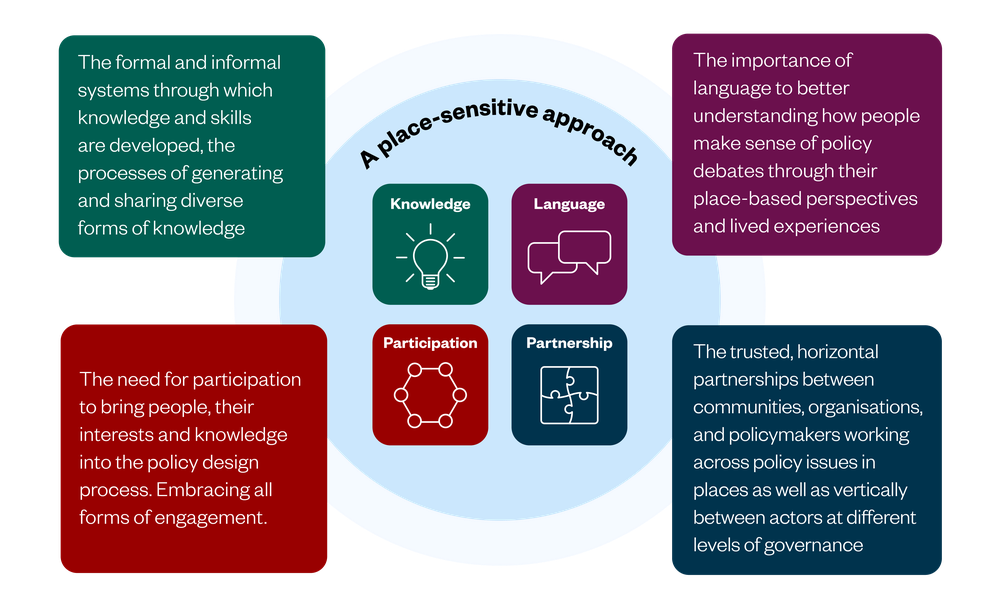
'Where we live next' has explored the role of place in public policy for the environment and climate, focusing on three strands: nature recovery, energy transitions and sustainable homes. In each case, attention has been on the importance of facilitating place-led and spatially appropriate policy interventions that can meet community needs.
The programme's recent and final report A place-sensitive approach for environmental sustainability captures how national and devolved government (and other layers of government without strong connections to place) can play a vital role in facilitating place-focused environmental sustainability policies and outcomes.
The approach is underpinned by four key interconnected features: knowledge, language, participation and multi-level partnerships:
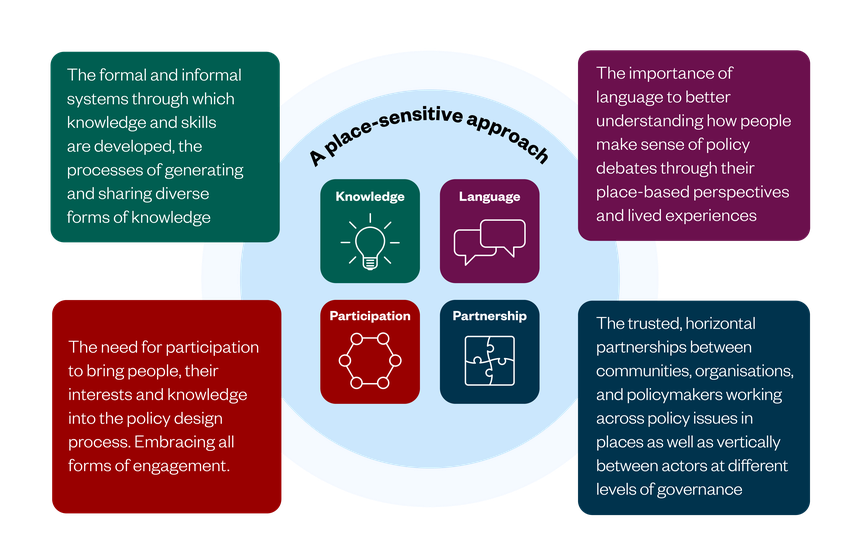
Attending to these features, national government can formulate policies that are more flexible to different needs and better embedded in place, as well as create points of reflection to strengthen and augment existing place-based activities.
Governance to accelerate net zero
The British Academy Net Zero Governance programme explored how improving the quality of governance can contribute to achieving net zero by 2050 in the UK. It's 2024 report 'Governance for Net Zero' highlighted the importance of governance to facilitate the urgent and decisive socio- and economic transformations needed to reach the goal set out in the Climate Change Act. The report highlighted the need for a public engagement strategy, echoing growing research findings. Following this publication, the British Academy convened a series of roundtables to ensure the latest social science and humanities research contributed to government thinking on public participation around net zero, which helped shape the 'UK Government Energising Britain Plan' published in December 2025.
The final report of this programme, Governance to Accelerate Net Zero, published in 2025 sought to cut through the complexities and frictions presented by the transformations demanded by the net zero target. It set out eight accelerators that emerged from the extensive review of evidence and engagement with policy, practice and research leaders:
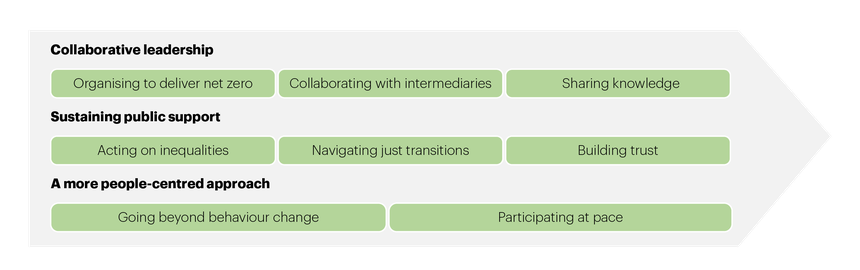
The report examines each of these accelerators in detail, drawing on the latest research and real-world case studies. It then considers how this approach to good democratic governance can be harnessed to support the types of collaboration between leaders, intermediaries and publics that research shows work best on net zero. In particular, the report highlights the importance of 'multidirectional interactions' that make the most of the combined power of markets, social interactions and networks of trust to drive this type of transformation.
Place-sensitive understandings of nature recovery in the UK
The Nature Recovery Discussion Paper Series gathers insights from SHAPE research into nature recovery policy and practice across the UK. From forests to inner city rivers, community art to artificial intelligence, prisons to highland mountains, this collection presents case studies and policy considerations for enhancing the place-sensitive approaches to nature recovery.
Nature underpins the everyday lives of citizens in the UK, supporting health, wellbeing and economies. Nature and people are connected through, for example, pollinating species, productive soils, urban green spaces, natural flood defences on coastlines.
However, the UK has become one of the most nature depleted countries in the world. Nature recovery describes the ways in which life on Earth is restored and enabled to flourish through better human-nature relationships. It raises an increasing number of policy questions, many of which need the rich insights from SHAPE research to answer.
This series of discussion papers open up some of these questions, explore current policy and practice and point to the challenges and opportunities for policymakers in this space going forward.
Future of the Corporation
The Future of the Corporation programme examined the purpose of business and its role in society, led by Professor Colin Mayer FBA, Emeritus Professor of Management at the Saїd Business School. In its four years of work prior to its conclusion in 2021, it combined research from a range of academic disciplines with insight from senior business and policy leaders. In 2018, it highlighted trust in business and its impact on people and the environment along with globalisation and technological disruption as drivers of a shifting view of business. The research suggested a need to develop a new, more human framework for the corporation around well-defined and aligned purposes, complemented by ethical cultures and commitments to trustworthiness. Professor Mayer drew together the research and defined the purpose of business as "producing profitable solutions from the problems of people and planet, and not profiting from creating problems."
The programme produced a set of principles for purposeful business in 2019 and built on these with extensive work involving a wide range of stakeholders to develop policy and practice in support of those principles. Beyond its conclusion in 2021, the programme has continued to have an impact and the Academy is supporting follow-up initiatives looking at how purposeful business is taught in UK business schools, and how the concepts it developed can be translated into law and regulation.
Publications
A place-sensitive approach for environmental sustainability
Governance to Accelerate Net Zero
Summary note: place-sensitive understandings of nature recovery in the UK
Governance for Net Zero
Lessons from the History of UK Environmental Policy
Understanding the role of place in environmental sustainability
Policy & Practice for Purposeful Business
Principles for Purposeful Business