Governance to Accelerate Net Zero - Report PDF
Download PDF reportExecutive summary
Net zero is a complex, systemic challenge. It demands good democratic governance to drive collective action across regions, sectors and communities.
The urgency for action has never been clearer, with rising average global temperatures (exceeding 1.5C above pre-industrial levels in 2024) (1) and severe climate impacts sitting alongside increasing and compounding vulnerabilities of people across social and economic dimensions. All aspects are further amplified by associated adaptation and biodiversity challenges.
The UK Government’s commitment to net zero—from the 2008 Climate Change Act to its mission to become a clean-energy superpower—is mirrored or raised by ambitious targets set by organisations, businesses and institutions across the country. With new technologies now available to reduce emissions, research and debate increasingly focus on the choices facing leaders given strained public finances, rising inequalities, intersecting vulnerabilities, polarisation and eroding trust in public institutions.
A major British Academy review over three years has analysed evidence and insights from SHAPE disciplines (Social Science, Humanities and the Arts for People, Economy & environment) to understand why and how good democratic governance is crucial to navigating these challenges. The evidence base for this programme encompasses funded research across ten research projects and sixteen research papers drawing on net zero initiatives across the UK and insights shared by over 200 stakeholders across research, policy and practice through national and local events, workshops and roundtables.
The findings, presented in this report, show a striking consensus: collaborative leadership across levels of government, place-led initiatives in partnership with intermediaries and a more people-centred approach to participation and net zero action are central to reaching net zero at speed.
This will mean action from each level of government in each part of the country. This report, therefore, is aimed at political and policy leaders across the UK at all levels of government, who are responsible for setting up governance mechanisms to:
- navigate complex, nuanced decisions, while maximising the opportunities presented by the net zero transformation; and
- connect decision-makers and diverse communities (facilitated by intermediaries) around actions that deliver, at pace, the collective action needed.
Examples in this report show how such mechanisms can deepen collaboration, bringing government, business, civil society and citizens together to accelerate action. While the challenges can create governance frictions which lead to inertia, this report argues that leaders can use the evidence, case studies and insights from researchers, practitioners and policymakers to instigate multi-level, multi-actor, multi-directional solutions that will accelerate action.
In the report we highlight case studies of good practice from across levels of government and across the country, from Aberdeen to Hackney, to draw out practical lessons for the journey ahead.
Accelerators for net zero action
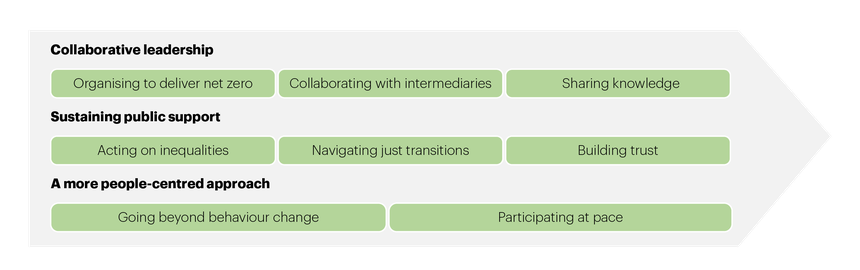
UK governance is creaking under the complexities of the net zero agenda, creating frictions that slow down delivery. Action from leaders can relieve these frictions or reverse them to bring about an acceleration. Eight accelerators that describe this type of action are presented in this report; understanding them and how they fit together is the starting point for acting on the practical challenges facing leaders on net zero. (See Diagram 1.)
Collaborative leadership
Catalysing collaborative leadership is central to accelerating to net zero, enabling coordination, knowledge sharing and collective accountability.
- Devolution provides an opportunity for leaders to build subnational governments’ capacity for dispersed, collective forms of leadership to reach net zero, and move away from competitive approaches slowing down delivery.
- Embedding collaboration with and between diverse intermediaries (such as community-based organisations, local businesses and researchers) through funding frameworks and support provisions is integral to facilitating place-led climate action.
- Knowledge sharing accelerates net zero delivery, with opportunities for leaders to build on and connect emerging good practice across places, scales and departments.
This section spotlights the governance challenges facing subnational governments, the translation of national policy to local action, the diversity of intermediaries, and case studies on collaborative efforts in low-carbon transport in Aberdeen and in Local Area Energy Planning in Manchester.
Sustaining public support
To sustain public support and make lasting progress, leaders should give due emphasis to trust, fairness and effectiveness, which must go hand-in-hand.
- Leaders can use targeting in net zero polices, including relatively modest changes to regulatory systems, to act on inequalities around the carbon emitting systems we still rely on and bring visible positive benefits to people’s daily lives.
- Transparent and inclusive governance in navigating just industrial transitions is essential to account for the inherent power imbalances between governments, multi-national enterprises, workers and affected communities.
- By giving greater attention to the networks of trust that publics engage in, and the transparency and trustworthiness of institutions and actors, leaders can build the confidence necessary to make progress towards net zero.
This section highlights factors driving inequalities and presents case studies on introducing solar energy to flats in Hackney, industrial transition planning in Grangemouth and the experiences of participants in the Copeland climate jury in West Cumbria.
A more people-centred approach
A fair, people-centred approach needs to go beyond individual behaviour change and scale up the pace of public participation to match net zero ambitions.
- People and their communities play a central role in initiating and facilitating the society-wide transformation necessary to reach net zero goals, requiring a whole-systems approach to make net zero the easy and cheap default.
- By working with intermediaries, leaders can deepen insights into how public participation and the success of net zero adaption are intimately connected to how people experience social, cultural and economic change in their daily lives.
- Commitments across levels of government to improve the use and reach of public participation provide opportunities to embed lessons from existing engagement and create more impactful polices, with greater accountability and oversight to publics.
This section examines how social and cultural factors and daily life shape the participation in and acceptance of net zero initiatives. It includes examples of deepening public participation and a case study on deliberative processes in the Climate Change Committee (CCC).
How can leaders work with publics to harness the accelerators?
With an understanding of the accelerators, leaders can work with publics and intermediaries through a series of governance mechanisms: direction and resourcing, place-led action, connecting knowledge, transparency, democratic accountability and public participation.
The mechanisms will be familiar to leaders, but set alongside the accelerators described in this report, they provide fresh insights into action that can be taken. The report also describes how they fit together in a model (see Diagram 2 and Table 6) that connects leaders, intermediaries and diverse publics, reiterating the multi-level, multi-actor and multi-directional approach necessary to galvanise net zero action across the UK.
Given the challenges around strained public finances, rising inequalities, intersecting vulnerabilities, polarisation and eroding trust in public institutions, developing and strengthening these governance mechanisms should be considered a central part of strategies to reaching net zero. The report’s concluding recommendations, therefore, focus on the priorities for leaders to use good democratic governance in support of net zero goals.
Policy recommendations on how to accelerate net zero
This report has argued that there are people- and place-sensitive, evidence-based options for leaders across levels of government to use good democratic governance to accelerate net zero delivery. The Mission Board, tasked with helping steer the UK government’s Clean Energy Superpower by 2030 mission and the acceleration to net zero, should sit at the heart of this process. The report recommends that it leads a comprehensive strengthening of governance across departments and at all levels to meet net zero targets, using the review of the Carbon Budget Delivery Plan as an opportunity to initiate this.
To support this recommendation, five strategic priorities for leaders describe the action needed across levels of government to increase and sustain the pace of progress. (See Table 1.) These strategic priorities are supported by starting points for action, with specific policy recommendations set out in greater detail in Section 6. The CCC’s annual progress reports to Parliament provides a means to assess and track progress on these priorities and to understand how governance is accelerating or holding back delivery across policy areas.
Report background
This report draws together the findings of the British Academy’s Net Zero Governance policy programme, with a focus on how the UK government, from local to national levels, can improve governance to support the acceleration of net zero. While speaking explicitly to the UK government’s Clean Energy Mission, it has implications across current and future government missions, which will all play a role in reaching a net zero future.
The evidence in this report helps us understand why good democratic governance is critical for accelerating to net zero (see Section 1), what that means in terms of eight specific governance ‘accelerators’ (see Sections 2, 3 and 4), and how governance mechanisms can accelerate and sustain net zero action (see Section 5).
Five strategic priorities, alongside corresponding recommendations, call on political and policy leaders at all levels of government to strengthen good democratic governance (see Section 6).
Evidence base
Leaders across the four nations of England, Scotland, Wales and Northern Ireland are seeking more evidence to understand how to deliver on the net zero mission with the urgency required and realise the opportunities it presents for the people and institutions they serve.
Since 2021, The British Academy’s Net Zero Governance programme has built on existing research and the direction of travel that researchers and policymakers have set, with over 80 researchers (including British Academy Fellows) involved through commissioned research and events. This includes:
- an 18-month research project focused on the links between local and national governance;
- 16 discussion papers drawing on varied case studies across a range of governance issues;
- a further nine small research projects exploring shared understandings of net zero and related issues.
Roundtables, workshops, individual meetings and events involving more than 200 policymakers, practitioners and other experts across the UK have connected the research and policy communities. (See Annex 1.)
The combination of the research evidence, the rich discussions convened around it and insights from wider literature provide the basis for the recommendations presented.
Agreeing on clear definitions is important for developing shared understandings of net zero futures and good governance. (See Annex 2.) In this report, ‘good democratic governance’ describes the democratic processes and activities concerned with working towards a shared purpose, through a clear strategy, with oversight and accountability. In practice, it can have a range of elements, such as establishing feedback loops for knowledge sharing across institutions, setting statutory duties for reporting to, or co-designing policies with, and accountable to, citizen and residents.
This report explores net zero as a multi-level, multi-actor and multi-directional systems challenge, the navigation of which will have significant implications for diverse publics and actors.
However, the report is addressed specifically to policymakers across government levels in the UK. Leaders are responsible for establishing the governance mechanisms described in the report and nurturing collaboration among all other actors. As such, they are best placed to act on the findings.
1. Good democratic governance is critical for accelerating to net zero
Research exploring human and social systems and drivers is central to understanding why and how good democratic governance can deliver and sustain the effort to reach net zero goals. Achieving net zero at pace has many complex features, in particular:
- The transformation associated with net zero affects a wide range of human activities, but how these broader impacts are navigated has not had sufficient focus from government.
- Getting to a net zero future is made more complex by existing inequalities within our society which will, without careful attention, result in the costs and benefits falling unfairly on different groups.
- A net zero future will not be sustainable without equally transformative action on adaption and to address biodiversity loss.
There is no quick fix to ensure that deep, rapid and sustained cuts to harmful emissions are delivered with the urgency required. Our analysis mirrors the CCC, The Intergovernmental Panel on Climate Change (IPCC), the Skidmore review and others, in highlighting what can be seen as a cumulative set of actions taken across places, scales and times. (2) With this growing need for coordinated action and increasing contestation as the onus shifts from industry to households, how can leaders navigate the challenges and create the conditions for more rapid delivery?
Good democratic governance is the critical enabler to accelerating to net zero. It provides the tools leaders need to navigate complex, nuanced decisions and maximise the opportunities from net zero. It also connects decision-makers with diverse communities around the urgent collective actions needed.
Good democratic governance describes the democratic processes and activities concerned with realising a shared purpose, through a clear strategy, with oversight and accountability. This kind of governance brings together a range of actions that support and inform decision-making, such as establishing feedback loops for knowledge sharing across institutions, setting statutory duties for reporting on progress or co-designing policies with, and accountable to, citizen and residents.
Poor governance may lead to poor strategies, cumbersome processes, uncoordinated activities and a lack of accountability that add up to frictions between actors. This results in a lack of progress towards the shared purpose.
Governance that is not democratic may result in greater inequality, exclusion from decision-making, corruption or a lack of direct and indirect accountability of political and policy leaders to citizens.
The increasingly divisive and political debates about how to reach net zero illustrate the risks to governance from growing gaps between leaders and publics. Citizens and diverse publics are influenced by and participate in the transformative changes resulting from leaders’ decisions. If publics are disconnected from decision-makers, decisions will fail to properly consider their diverse interests and values.
1.1 Accelerators
This report builds on the British Academy’s earlier report, 'Governance for Net Zero' (3). It digs deeper into how good democratic governance can accelerate progress towards net zero goals and identifies the frictions arising from lapses in governance that slow down delivery.
It sets out eight specific accelerating factors grouped according to three main areas. Together, these accelerators can enable good democratic governance (see Diagram 1) and the next three sections of the report elaborate on each one, drawing practical insights from the evidence base our disciplines provide. This includes insights from the British Academy and its many contributors on what works (and does not) to improve governance and accelerate to net zero.
Diagram 1: Governance accelerators for net zero.
The accelerators provide a way of thinking about governance that relates it to the practical challenges facing leaders.
1.2 Governance mechanisms
In Section 5 of the report, findings across the accelerators, and their associated case studies, are brought together to identify how leaders, working with wider actors, can harness the accelerators. A model for governing collaboration on net zero accelerators identifies:
- The existing governance mechanisms that leaders can use to harness the accelerators, working with publics and through intermediaries;
- The interactions between intermediaries and publics that can amplify or hinder net zero transformations, and influence or are influenced by governance mechanisms; and
- Lessons for how leaders can improve the efficacy and take-up of net zero initiatives through the mechanisms available, and better account for the role of interactions between intermediaries and publics in net zero transformations.
Finally, the report concludes with a primary recommendation for a dramatic strengthening of governance across departments and at all levels to meet net zero targets. This comes alongside five strategic priorities, supported by specific policy recommendations, for leaders to apply these lessons in governing the acceleration to net zero.
2. Collaborative leadership
Net zero is a global, national and local collective action problem, requiring collaborative leadership and activity across places, scales and times. The British Academy’s 2024 'Governance for Net Zero' report highlighted leadership across levels of government as a crucial but underutilised lever in the net zero agenda. (4)
In the context of this report, leaders are those in government who are accountable to publics, and direct and design accountability for net zero commitments. Leaders play different roles across political leadership (such as Members of parliaments, Mayors, or local Councillors) and wider policymaking (such as civil servants across levels of government). They can create a collaborative environment in and between government levels, and for private and third sector leadership to support delivery. As government leaders in a democratic country, they are either directly accountable to citizens and residents, or indirectly accountable through elected representatives.
Given their central role in good democratic governance and in establishing the mechanisms this report explores, the first three accelerators fall under the heading of collaborative leadership: Organising to deliver net zero, Collaborating with intermediaries, and Sharing knowledge.
2.1. Organising to deliver net zero
Coordinated action is pivotal to enabling the cumulative and connected leadership necessary to realising the UK’s legally binding net zero commitments. A failure to coordinate effectively across places, scales and levels of governance is repeatedly cited as a friction that slows down or hinders net zero delivery. (5)
Insight from research funded by the British Academy has highlighted that governing net zero involves fostering meaningful participation of diverse actors and publics to improve collaborative coordination with a focus on organising to deliver rather than simply organising delivery. Effective governance of net zero can be enabled by dispersed, collective forms of leadership, with the state (across levels of government) leading the charge on net zero for the public good (6).
This research identified seven governance challenges that underpin this approach at subnational scales (see Table 2).
The organising to deliver approach puts the focus on how place leadership can take a diversity of forms and pathways, and how building subnational capacities and connectivity to regional and national levels can accelerate collaboration on the net zero mission, rather than a disconnected and competitive approach that amplifies the frictions. Box 1 illustrates case studies of how frictions between local and national levels of government can emerge as unintended consequences of a fragmented approach to resourcing and directing action.
Diversity in subnational governance and net zero actionability
Four research papers funded by the British Academy (14) explored how national net zero policy and funding translates to local actionability and leadership, drawing from case studies across the West of England, West of Yorkshire, the Midlands and Aberdeen.
There is significant diversity in government structures in the UK, with a plethora of scales and state actors, each with differing responsibilities, taxation powers, capabilities and place attributes.
Overlayed onto this is the UK national system, which is heavily centralised for local tax raising and is seeing a rapid real-term decline in local spending. This has several implications for place-sensitive net zero action that the four papers highlight:
- There is a lack of clarity at the national level over how net zero ambitions translate to place-based action, with limited applicability of national policy instruments to local implementation and a strikingly small or absent role for many instruments that could support policy translation.
- Significant differences in local climate action priorities reflect how well their geographical context or scale, resourcing (in terms of staffing, funding and skills) and previous investment positions them for accessing competitive funding or grant awards for different types of net zero action.
- Centrally held competitive funding mechanisms and fiscal constraints on local authorities have resulted in an uneven spatial distribution of net zero initiatives. Previous top-down net zero investment has concentrated resources in specific places, creating a risk of widening regional and place-based inequalities by creating industrial ‘Super Places’. In subnational investments such as the City Deals, climate priorities are low and unevenly distributed, with a predominantly economic framing, a regional focus which bypasses local scales and actors, and a competitive ethos.
- Local authorities’ ability to lead local policy innovations for net zero are constrained by limited legal power in key areas (such as housing, transport and agriculture), regulatory barriers and competing duties in other policy areas, and political divisions on the prioritisation of net zero in and across institutions.
These frictions have resulted in highly varied ambitions, targets, priorities and progress towards net zero across the country. As a result, a postcode lottery on net zero readiness has tended to favour well-resourced urban local authorities, which can best mobilise public and private investment and negotiate the inclusion of net zero initiatives. This constrains local leaders who are well placed, but poorly resourced, to take appropriate action.
These research papers highlight the constraints to net zero action at subnational levels, with regional and local leaders facing trade-offs between delivering net zero and other priorities under significant fiscal strain. They demonstrate the potential for decentralised autonomy (in terms of powers and resources) to effectively enable place-based collaborative leadership.
The Government’s 2024 English Devolution White Paper is a promising step for extending devolution in England, including in net zero strategy and planning in highlighting a strategic role for subnational governments in the delivery of the Local Power and Warm Homes Plans. (15)
Central government leaders should incorporate the organising to deliver approach to improve coordination across levels, and resolve conflicting policies between departments and place-based inequalities in subnational investment and policy translation.
Mechanisms for ‘organising to deliver’
This report is building up a picture of a model for leaders, working with publics and intermediaries to harness the accelerators to speed up delivery on net zero across places and scales. This first section articulates the role of leaders across levels of governance in ‘organising to deliver’ to support multi-actor processes. Leaders across government can take action through a range of governance mechanisms:
- Shape approaches in direction and resourcing to improve the capacity of a range of subnational governments to coordinate and collaborate on net zero actions.
- Reduce uncertainty across levels of government and wider actors by improving the certainty and diversity of net zero policy translation instruments.
Strengthen connected knowledge bases as a multi-directional mechanism to inform decision-making and improve the efficacy and equity of processes and outcomes.
2.2. Collaborating with intermediaries
Intermediaries occupy spaces between bottom-up and top-down initiatives, and their actions are key to collaboration across places, scales and sectors. They have varying levels of agency, with some specifically set up to facilitate action on net zero, while others adopt this role. (16) These actors can establish and embed shared collective understandings of net zero challenges and locally relevant solutions, helping bridge publics and government. They operate in several ways:
- Working with people, by supporting engagement, policy co-design and building trust in downstream activities within communities.
- Supporting leaders, by identifying opportunities for scaling up initiatives and developing upstream solutions.
- Partnering with other intermediaries through supply chains, sharing knowledge and testing new practices to reduce direct and indirect emissions. (17)
Intermediaries are as diverse as the communities and places they serve. Table 3 provides examples of intermediaries to illustrate the frictions they face, and the opportunities they bring to net zero transformations. In some cases, such as local authorities, they can act as both leaders or intermediaries depending on the role they take in different net zero policies and initiatives.
Before considering the role of intermediaries and the benefits of collaboration and partnership, it is important to highlight two points:
- What is possible or appropriate for one place and its ecosystem of actors, may not be reflective of others. (23) In the case of SMEs, typical regional grant funding (largely focused on carbon reduction, energy efficiency and renewable energy installation) struggle to reach 1% of SMEs in a given region. (24) Rural areas face unique challenges, with highly dispersed populations, poor transport links and remoteness. They also have advantages: potential for renewable energy generation and nature-based solutions. A place-sensitive approach is required to maximise the potential for collaboration on net zero delivery. (25)
- Hands-off market and technology-led approaches have limitations for building the momentum necessary. They often exclude place-based or regulatory innovations that could unlock wider net zero opportunities driven by intermediaries—such as not-for-profit community models, shared ownership, practice transformation and an expanded role for local authorities. (26) The British Academy’s Future of the Corporation programme highlights how business policy and practice have led to a focus on financial goals, sometimes at cost to the environment. It argues for a legal, regulatory, governance and reporting framework to enable and create accountability for purposeful business, creating profitable solutions for the problems of people and planet. (27) This is reflected in a discussion paper funded by the Net Zero Governance programme, which suggests embedding net zero as a cross-cutting objective in commercial law and regulations. (28)
If these factors are given due consideration, collaboration with and between these actors is not just desirable, but integral to net zero social transformations and accelerating climate action. (29)
For example, Case study 1 illustrates a Local Authority becoming a place-leader and early adopter of low carbon technologies, thus helping to create enabling conditions for wider net zero development and a local context conducive to industry investment (that is, an intermediary) that sustains action beyond project delivery. (30)
While this case study draws out lessons for collaborative place-led action, the pursuit of hydrogen in light surface transport has since revealed practical limitations, showcasing the challenge of forging locally appropriate pathways with incomplete information on emerging technologies.
Case study 1: Leadership in low-carbon transport in Aberdeen
A discussion paper commissioned by the British Academy (31) drew on interviews, roundtable discussions, site visits and existing literature to explore how Aberdeen City Council forged a locally appropriate pathway in hydrogen transport over 10 years, with the support of EU Horizon funding.
The EU Horizon Funded Consortium approach, grounded in an ethos of collaboration, supported the Council to:
- Collaborate nationally and internationally with partner towns and cities, supporting collective purchasing, and enabling sharing of data and learning.
- Develop a new partnership with a private technology provider in England, enabling the rapid retrofit of their vehicle fleet and mitigating risks from the lack of existing supply chains, and continued support for hydrogen upskilling for the Council.
- Develop a Car Club scheme, allowing local partners and residents to access hydrogen vehicles and providing low-cost opportunities to trial the technology.
This case study makes the argument not for this specific technology, but for the approach used. The individual and collective leadership from the evolving in-house team of proactive, driven and competent people accelerated the application of this technology, nurtured and sustained strategic partnerships and provided continuity. Aberdeen City Council has since built on this approach, securing funding from Scottish Government Energy Transition Fund (32) and formed a partnership with BP to open a new hydrogen hub in the area. (33)
While the specific circumstances of this case study in Aberdeen, a wealthy city with a history in the oil and gas industry, will not be replicable elsewhere, the general lesson from this example is around a place-led collaborative approach.
This was combined with identifying and developing partnerships with intermediaries, including funders and industry, while taking care to align interests. If left unchecked, inequalities between people and places can act against this type of approach, as discussed in Section 3.1.
Mechanisms and interactions for ‘collaborating with intermediaries’
This section emphasises the opportunities and emerging good practice in ‘collaborating with intermediaries’ through putting in place enabling conditions for intermediaries to play the supportive roles discussed here. Leaders across government can take action through a range of governance mechanisms, while taking account of interactions between intermediaries and publics:
- Reflect the diversity of intermediaries and their interactions with publics through market interactions, networks of trust and social interactions, which are explored in more depth in Sections 3 and 4 of the report.
- Embed place-sensitive direction and resourcing to strengthen collaboration with intermediaries through subnational funding frameworks and more targeted regional net zero support provisions.
Work with intermediaries to develop place-led action, which can be supported or scaled up further with coordination from government leaders.
2.3. Sharing knowledge
A striking highlight of the British Academy’s stakeholder engagement and commissioned research has been the importance of multi-directional knowledge sharing for the collaborative effort to reach net zero. Knowledge sharing accelerates net zero delivery by:
- Using place-based knowledge and citizen preferences to inform decision-making;
- Creating more cross-cutting action on environmental, social and economic priorities;
- Encouraging multi-actor collaboration, confidence and partnership working;
- Improving transparency and oversight of decision-making; and
- Supporting the development of and learning from what we know works (and does not). (34)
Local authorities, combined authorities and other regional agencies (such as net zero hubs) are well placed to leverage localised data and facilitate knowledge exchange across a range of actors throughout the development and implementation of net zero schemes. (35) Conversely, informed decision-making can be hindered when knowledge bases are disconnected and data gathering and analysis are inconsistent. (36)
Innovative practices to develop holistic understandings of local interests and needs are emerging across councils and devolved administrations (such as Local Investment Plans, Local Area Energy Planning, locally determined contributions and other projects) and from other actors (such as peer learning networks, sustainability hubs and digital platforms). (37)
Case study 2 illustrates lessons from one of these innovations: Local Area Energy Planning.
Case study 2: Greater Manchester’s Local Area Energy Planning (LAEP)
A discussion paper commissioned by the British Academy (38) examined the Greater Manchester Combined Authority’s 10 district-level LAEPs, developed in 2021. LAEPs use a data-driven, whole-system approach to understand the most cost-effective way of delivering net zero in a particular region and set out an action plan for implementation. They can serve as a springboard for local capacity building and engagement.
For Greater Manchester, the LAEPs had a range of strategic benefits, enabling them to articulate the scale and cost of the decarbonisation challenge, identify geographical priority areas and interconnected challenges, and secure significant central government funding. Interviews with officials revealed a range of potential enablers for LAEPs:
- The depth of the plans depends heavily on available funding and in-house analytical resources in a local authority (including their maintenance, updating and monitoring).
- LAEPs necessitate a shared data literacy standard to ensure local energy plans can be read and developed by all stakeholders.
- There is a need to develop a data sharing culture, through valuing local information equally to national data, establishing clear roles and responsibilities to support information governance and engagement at the council level. Sharing should be balanced with mitigating for risks of commercial exploitation of sensitive data.
These findings underscore the importance of a transparent, people-driven data culture based on frequent, informal exchanges that enable adaptations and effective planning.
Knowledge-sharing innovations could strengthen holistic planning and be complemented with engagement activities in the community. (39) To reap their full benefits, national government will need to act on unequal data maturity and inequities in funding. (40)
This echoes findings from the British Academy’s programme on place-sensitive sustainable policymaking, which stresses that local knowledge, which is vital for effective evidence-based policy, relies on the right mechanisms, networks and cultures being in place. (41)
Connecting knowledge sharing across places and scales can further facilitate learning and exchange on emerging solutions and challenges and help identify initiatives that could be scaled up. (42)
A platform being trialled as a part of Innovate UK’s Net Zero Living programme illustrates the potential for doing this across local authorities. However, as it is only accessible to around 50 local authorities and their partners, it would need to be scaled up across the UK and resourced to ensure it does not exacerbate capacity constraints.(43)
Research stresses the need to gather and link expertise across disciplinary and geographic boundaries to improve the success of net zero policies. Leaders in politics and policymaking across government can look to integrate SHAPE (Social Science, Humanities and the Arts for People, Economy & environment) insights earlier into decision-making, improve assessment of progress and knowledge on how people will be affected by policies and share insight across departments and scales to take integrated action on net zero. (44)
The Government’s five missions also provide opportunities to connect disparate networks with knowledge across scales and places that could support net zero delivery (and vice versa).
Mechanisms for 'sharing knowledge'
This section showcases the value of and emerging good practice in ‘sharing knowledge’ to improve the efficacy and equity of decision-making and governance processes and outcomes for reaching net zero. Leaders across government can take action through a range of approaches in governance mechanisms:
- Connect knowledge bases between leaders, intermediaries and publics, and break down silos between places, disciplines, levels and networks.
- Support place-led action on knowledge sharing and build connectivity between places and scales by strengthen capacities, cultures and consistency in knowledge sharing practices.
3. Sustaining public support
Reaching net zero will require significant changes to how people and communities live, work and interact in their day-to-day lives. The nature and impact of these changes will vary widely across different places and communities. (45)
A well-governed transformation presents a range of opportunities to bring benefits to daily lives, from improved health and comfort to good-quality jobs. (46) Discussions with academics and practitioners in the British Academy’s Net Zero Governance programme have emphasised that there is clear evidence of public support in the UK for a more sustainable future, but it is the conditionality of this support that matters.(47)
Sustained and resilient public support will require governance which accounts for a range of pre-existing and cross-cutting frictions in the relationship between leaders and diverse publics, including in the distribution of costs and benefits and public trust in net zero policies. This is exemplified across analysis from the British Academy, the CCC Seventh Carbon Budget, IPCC Sixth Assessment report and others. (48)
Publics play a foundational role for holding leaders to account as part good democratic governance. In light of their active role in governance mechanisms, this section highlights three accelerators that can help sustain the foundations for public support: acting on inequalities, navigating just transitions and building trust.
3.1. Acting on inequalities
Economic, social and health inequalities are deeply entwined with the climate crisis and the carbon-emitting energy systems we still rely on. Bringing these systems to net zero will increasingly require people across places and communities to undertake noticeable changes, which could disproportionately affect people who are already facing marginalisation, poor health and low incomes. (49)
Good democratic governance will need to both incorporate understandings of these inequalities and work actively to avoid exacerbating them. Indeed, the potential benefits the energy transition represents provide opportunities for government leaders to take action to reduce inequalities.
There are large differences in personal carbon emissions, and each individual’s ability and readiness to reduce them. (50) In 2019, the flights of the wealthiest 10% in the UK used more energy than the total used across all aspects of life of the poorest 20%.(51)
The current energy retail market is resulting in poor outcomes for inactive consumers and overcharging by utility firms is found to be routine (particularly for those on pre-payment meters). (52) The most vulnerable households have become saddled with over £3 billion in unserviceable debt, and fuel poverty in the UK is estimated at close to 5.6 million households as of July 2024, contributing to excess winter deaths at a range of at least 3,000 people per year. (53)
What is perceived as fair may vary, influenced by a range of factors such as a person’s capacity to act and their values and beliefs. Of particular importance is fairness in the distribution of costs and benefits, and in involving diverse perspectives in the process of decision-making (especially groups affected by net zero polices and the changing climate). (54)
Fairness extends beyond easily conceived timeframes, encompassing future generations and their right to a clean, healthy and sustainable environment. (55) This poses serious implications for intergenerational inequities. It also highlights questions of: who bears the responsibility of past and present harmful emissions; who bears the costs for current inaction; and whose voices and concerns are left unheard? (56)
Good democratic governance provides crucial accelerators (see Table 4) to leaders in politics and policymaking with a responsibility to navigate this nuanced context while meeting the government’s mission on clean energy and accelerating to net zero.
Case study 3 illustrates how relatively modest changes in regulatory and governance systems can act as accelerators for locally meaningful collective participation. It explores a specific example of addressing upstream barriers to participation and bringing visible positive results in people’s daily lives at speed while supporting net zero goals. (62)
Case study 3: Solar for flats in Hackney
There has been a recent expansion in local energy and related business models around the potential for Smart Local Energy Systems (63). However, due to presumptions in energy market regulations of atomised household units, most models do not work for certain types of dwellings or tenure.
England and Wales have over 5.4 million flats, but no model had been created for occupants to benefit from communal solar energy.
Emergent Energy has worked with Ofgem through their regulatory sandbox service, which investigates the changes needed to energy market regulations, and with Hackney Light and Power, to understand the barriers to provisioning a microgrid and metering and billing infrastructure to flats in Hackney, so residents can benefit from solar energy.
The council owns the equipment and repays the capital through energy bill payments, and tenants face no up-front capital costs. The scheme is expected to pay for itself while enabling the average resident to save 20 per cent from their energy bills. Due to its success, Hackney Council has raised investments to extend the scheme to council-owned homes.
To allow the trial to take place, Ofgem needed to grant derogations across a range of regulations in the supply licensing regime and Balancing and Settlement Code and are working towards adapting these so that the model could be replicated.
The UK Government’s commitment to deliver a Local Power Plan provides a promising opportunity to accelerate shared ownership models between developers, communities and local government, and to help accelerate local energy systems for a wider range of communities.
To do this in a way that will bring the benefits of net zero to communities more quickly, the UK Government should seek to understand and target geographic or socio-demographic communities currently lacking agency or social networks to participate in net zero. Using this targeting, policymakers can design energy policy, through incentives and changes to regulations, to benefit these communities. (64)
Mechanisms and interactions for ‘acting on inequalities’
This section highlights the significant inequalities faced by publics and how ‘acting on inequalities’ can improve the success of governing net zero within an unequal society. Leaders across government can take action through a range of governance mechanisms, while taking account of interactions between intermediaries and publics:
- Deepen their understanding of how inequalities constrain the social and market interactions that people can use to participate in net zero.
- Consider how exclusions from public participation result in ineffective policies.
- Improve direction and resourcing to widen participation through cross-cutting action on inequalities and reaching net zero by targeting the communities facing social, economic and place-related barriers. This can be achieved through relatively modest changes to regulatory systems and incentives, and through enhancing oversight in a way that incorporates an understanding of inequalities and perceptions of fairness.
3.2. Navigating just transitions
The urgency of the climate crisis necessitates a move to more inclusive and holistic industrial transition planning as a part of wider net zero transformation. The British Academy’s report on the Lessons from the History of Regional Development Policy in the UK stresses how deindustrialisation has left a challenging legacy, with some communities still bearing the scars of rapid and unplanned change. (65)
As some places in the UK have developed around high-carbon industrial clusters—such as Grangemouth, Port Talbot, Humberside, Merseyside, Southampton and Teesside—transitioning away from these sectors has had and will have a profound effect on their communities. (66)
The British Academy’s international programme on Just Transitions points to the key role of just transitions to support the development of an inclusive and sustainable future. This comes with the need for policymakers to engage communities, workers and businesses to identify opportunities and barriers to decarbonisation. It underscores the importance of addressing different dimensions of justice—including distributive, restorative, intergenerational and procedural justice—as a part of the planning process. (67)
However, research suggests that there has so far been limited action at the national level on embedding these factors and their intersections meaningfully to improve the reach and efficacy of net zero policies. (68)
The UK’s experience with just transitions is concentrated in Scotland, where a series of climate change strategies and legislative changes integrated just transition governance with achieving net zero—both in the outcome (a fairer, greener future for all) and the process of doing this in partnership with those impacted. (69)
The Climate Change (Emissions Reduction Targets) (Scotland) Act 2019 legislated a set of just transition principles, which underlined central procedural and substantive dimensions, including the importance of multi-party dialogue and investing in sustainable activities that build on the skills, capacities and infrastructure of a place. (70)
Scotland was the first nation in the world to establish a Just Transition Commission, to provide independent scrutiny and advice on how to put justice at the heart of climate action. (71)
While this leadership has been vital in shaping the discourse around just transitions, Case study 4 demonstrates the deep political and economic frictions complicating its governance.
Case study 4: Transition planning and tensions in Grangemouth
A research paper commissioned by the British Academy (72) analysed the closure of the Grangemouth Oil Refinery, drawing on historical insights, proceedings from parliamentary committees, Scottish Government plans and interviews with workers.
Some 2,822 jobs are directly dependant on the refinery, and it has major implications for the regional economy and labour market in Central Scotland. Its owner since 2011, Petroineos, is a partnership between INEOS and PetroChina.
Grangemouth has been a focal point for discussion over power and justice in Scotland’s energy sector for decades, including INEOS previously threatening closure in 2013, and both the Scottish and UK Governments providing investment support to secure a long-term future for Grangemouth in 2014. Petroineos’s announcement in November 2023 of the closure by 2025 came as a shock to workers and governments alike.
Grangemouth has been central in Scottish Government’s just transition policy, including:
- The Grangemouth Future Industry Board (established in 2022);
- In the Draft Energy Strategy and Just Transition Plan (Published January 2023);
- An inquiry by the Scottish Parliament’s Economy and Fair Work Committee which Petroineos refused to engage with (published June 2023); and
- A discussion paper outlining a Just Transition Plan for Grangemouth (published September 2023, seven weeks before the closure announcement).
While including hopeful projections of its hydrocarbon future, the plans lacked transparency, and contained minimal concrete commitments or steps to create accountability or oversight between transition partners. A Just Transition Commission report, published in July 2024, expressed the difficulties and power imbalances associated with the closure. (73)
The workforce’s faith in employer and policymaker commitments was undermined by the unexpected announcement and dissonance between the planning objectives and the reality of decision-making. Workers expressed frustrations at being denied the agency to enact a transition with the skills and infrastructures in their community and are left with a decision between migrating or insecure and lower quality employment.
Recent activity and cooperation around Grangemouth by the Scottish and UK Governments demonstrates the delicate potential for coordinated action to reinvigorate governance structures and create more equitable change.
Where the capacity to act is in the control of major emitters, power imbalances between governments, multi-national enterprises (common in the British energy sector) and workers present distinctive frictions to establishing relationships conductive to effective just transition governance.
Workers’ commitment to staying and helping drive forward the transition for the benefit of their homes and communities should be better supported and harnessed throughout transition governance. (74)
Research into three UK industrial heartlands from the Industrial Decarbonisation Research and Innovation Centre has found technocratic framings of ideal futures coming into competition with host-community concerns. The research pointed to a deficit of public engagement and a widespread lack of trust in both government and industry as major risks to industrial decarbonisation. (75)
Similarly, the research paper on Grangemouth (Case study 4) found the need for place-sensitive planning that accounts for local needs, histories, experiences of unfairness and the impacts of such transitions on families, children and communities. (76)
Lessons from Scotland’s leadership and the challenges faced in Grangemouth illustrate the need to embed just transition principles across governance structures and processes, with a focus on improving relations between government and affected communities and creating oversight for the actions of industrial transition partners.
Mechanisms and interactions for ‘navigating just transitions’
This section illustrates the importance of ‘navigating just transitions’ with careful consideration of the concerns of host communities as a part of planning to improve outcomes in affected places. Leaders across government can take action through a range of governance mechanisms, while taking account of interactions between intermediaries and publics:
- Account for the complex power imbalances in market interactions influencing the ability of all actors to navigate just transitions in communities.
- Provide transparency between transition partners and work to reduce uncertainty for affected communities, for example through multi-party governance and investments conditional to emitters participation in just transition processes.
- Use public participation in just transitions, inclusive of workers and communities, to develop more concrete medium and long-term plans that account for local concerns and strengths.
3.3 Building public trust
Public trust and good democratic governance are intrinsically linked, with trust playing a key role in facilitating commitment, collaboration and participation in the net zero transition. (77)
The complex dynamics between mistrust, scepticism and accountability, distrust and polarisation make this a challenging area for leaders. (78) Understanding these dynamics and investing in governance systems that build and sustain trust will be crucial to reducing frictions between leaders, intermediaries and communities in support of net zero goals and developing public acceptability of net zero initiatives.
Indicators point to a worrying state of public trust in the UK. The Office for National Statistics estimate that in 2023 only a quarter (27 per cent) of people reported high or moderate trust in the UK Government. (79)
According to the Edelman Trust Barometer, in 2024 the UK reached the lowest levels of trust since 2018, with increasing distrust of government, media, businesses and establishment leaders. (80) This lack of trust extends to relationships between places, institutions and key net zero partners such as businesses and charities, impacting confidence in net zero delivery. (81)
Notably, there are nuances within these relationships, with local government and the civil service experiencing higher levels of trust with publics than national politicians. (82)
Contestation and conflict are a normal part of transitions, with recent and historical evidence of this in environmental policymaking. (83) However, concerns over ‘net zero scepticism’ in the UK should not be exaggerated, as there is widespread concern and ambition to see greater action on the climate crisis. (84)
For example, the Yale Programme on Climate Change Communications found that in November 2024, 68 per cent of people in the UK thought climate change should be a high or very high priority for the government, with 82 per cent supporting the use of renewable energy to power and heat their homes. (85)
Our stakeholder engagement, funded research and wider policy programmes have highlighted the importance of avoiding contributing to polarisation and recognising that contestation often points to valid concerns or interests. Approaches which explicitly or implicitly attempt to correct a knowledge deficit among publics do not inherently build trust. (86)
Policymakers should account for the public’s desire for nuance and transparency, acknowledging multiple priorities and the diversity of evidence—across research and lived experience—in shaping policy developments. (87)
Trust in collective action for change can be influenced by the perceived fairness of the process and outcomes of polices, reiterating the importance of acting on inequalities and just transition planning as part of reaching net zero. (See Sections 3.1 and 3.2.)
Greater attention should be placed on whether institutions and actors are seen as trustworthy—with respect to their honesty, competence and reliability—to deliver the necessary change. (88) As illustrated across this report and our commissioned research, how governance approaches to net zero take shape can increase or erode the perceived trustworthiness of the government, and its ability to deliver changes fairly. For example, Case study 5 illustrates that, while participatory processes can build trust in UK governance systems, this can dissipate or reverse where institutions are not seen to act in line with the conclusions of these processes.
Case Study 5: Copeland climate jury in West Cumbria
In July 2021, 30 residents took part in the Copeland People’s Panel to explore what the local area should do to respond to climate change, providing recommendations to the council in hopes that they could lead to significant change.
However, in the following two years, limited progress was made on the recommendations, and Copeland Council did not communicate with ex-panellists about their intentions around implementation. Interviews conducted with eleven of these ex-panellists in January 2024 revealed that many felt disillusioned and disappointed by the process which (after renewing their hopes) served to reinforce their previous scepticism in political systems’ capability to deliver significant change.
"I think it’s how much hope we had. We'd done all done this, and we all felt … we can actually make a difference. We can actually do this. Looking back at it, none of it has happened. I feel like none of it's happened. You know, we were all so hopeful." (Climate jury participant)
This underscores the importance of demonstrating where and how public recommendations have been incorporated into local planning. Following this case study’s findings, key stakeholder organisations are working to address these challenges.
Public participation, and how it is embedded into decision-making, are key aspects in networks of trust. Trust building occurs through diverse, non-linear practices—influenced by existing affiliations, exposure to net zero and day-to-day relations. (91) This suggests that a focus on forming these social relations and encouraging action across trusted voices in communities—such as GPs, local researchers, community and faith leaders and neighbours—could help form the bonds and dialogue necessary for longer-term change. (92)
The confidence of intermediaries and publics to participate in net zero and collective action can be impacted by the state’s perceived commitment to net zero. It is critical that those with responsibility for governing net zero recognise the importance of relationships and networks of trust. (93)
Governance actors across scales should recognise that every policy and action on net zero is an opportunity to win trust—or erode it.
Mechanisms and interactions for ‘building trust’
This section illustrates the importance of ‘building trust’ to improving collaboration and maintaining momentum with intermediaries and publics on the collective effort to reach net zero. Leaders across government can take action through a range of governance mechanisms, while taking account of interactions between intermediaries and publics:
- Strengthen democratic accountability to diverse publics by placing emphasis on the transparency and trustworthiness of institutions to improve perceptions of the government’s efficacy to take the lead on reaching net zero.
- Deepen their understanding of the diverse networks of trust that publics and intermediaries participate in that influence their trust, confidence and participation in net zero action.
4. A more people-centred approach
To reach net zero goals, a rapid and society-wide transformation is necessary. (94) Insights from our funded research and stakeholder engagement, reflecting analysis across the IPCC, CCC, and the Skidmore Review, highlight that people and their communities play a central role in initiating and facilitating the society-wide transformation necessary. (95)
In the Governance for Net Zero report, the British Academy emphasised a people-centred approach as crucial to achieving net zero rapidly and effectively. (96) This entails government leaders embedding a deeper understanding of the diversity of publics to create more impactful policies.
Good democratic governance of net zero requires leaders to put the agency, concerns and strengths of affected communities at the heart of net zero policy development and implementation. By taking a whole-systems approach and learning from existing net zero engagement, leaders can identify upstream net zero interventions, work with social and cultural drivers, and make participating in net zero the easy and cheap default. (97)
Given the role of diverse publics in shaping net zero transformations and the success of governance mechanisms, this section highlights two governance accelerators that support a fair, people-powered transformation: going beyond behaviour change and participating at pace.
4.1. Going beyond behaviour change and technofixes
Individual behavioural change, technocratic approaches and downstream solutions have been prevalent in discussions on people’s role in the UK’s net zero agenda. However, there is limited evidence of their efficacy to affect sustained change on their own. Downstream tools can create frictions by amplifying inequalities and overlooking specific groups or places lacking existing trusted networks, experience or participation in net zero. (98)
Going beyond this individualised view of behaviour change draws on research which highlights how environmental policy, including net zero, is intimately connected with social, cultural and economic change. That is to say that behaviour is part of the system, and a collective, holistic or systems-based approach is needed to enable this accelerator. Table 5 provides examples of social and cultural factors which illustrate this thinking, drawing on research from across our disciplines, including the British Academy’s contributions and stakeholder engagement.
A focus on social and cultural factors emphasises how participation in net zero policies and technologies is interconnected with peoples’ lived and social realities, which include, but go beyond, net zero. Box 2 draws on two research papers on public engagement funded by the British Academy to explore the role of social interactions in community perceptions and acceptability of place-based decarbonisation pathways.
Box 2: Daily life and the acceptability of place-based decarbonisation
Two research papers funded by the British Academy (103) explore how net zero transitions connect to people’s day-to-day lives and place-based priorities. Both papers draw on public engagement methodologies conducted by the researchers—including case studies in Port Talbot (a coastal industrial town in South Wales), Rugeley (a rural town with a former coal-fire powered station) and Brockmoor (across six streets in Dudley, West Midlands), and projects with multiple sites across the UK.
They reveal the vast influence of social interactions and daily life on trust, social acceptability and engagement in net zero technologies and practices:
- People engage with the implications of future socio-technical transformations in deeply emotional, ethical and relational ways, with concerns on the impacts of change on others around issues of vulnerability, equity and fairness, reflecting society-wide dependencies on energy and pre-existing community precarity.
- Experiences of time (past, present and future) plays a significant role in people’s perceptions of risk and prospective change—linking the pressure and urgency for climate action to uncertainties from local industrial legacies, concerns of lock-in to untested technologies or undesired governance regimes, and competing pressures on daily lives (such as moving house or a birth of a child).
- ‘Word-of-mouth’ and trusted peer networks can influence the adoption of net zero technologies and practices, with stronger diffusion of adoption in more socially connected neighbourhoods, while multiple weak social ties are more likely to build awareness around negative messages.
- Place-based identities, attachments and pride can contribute to a person’s risk perception and level of support for energy technology innovations and environmental protection—shaped by historical, social and environmental factors, and can be further complicated by local distinctions in identity and the regularity of travel across areas.
- Public spaces, such as community buildings, outdoor and green spaces can support adoption and envisaging pathways to change by bringing private net zero technologies and practices that are often hidden (such as low-carbon home heating) into public visibility.
The complexity and diversity of social factors influencing public participation and acceptability of net zero futures stresses the need for open and creative design of public engagement approaches, which meets people where they are and provides multiple avenues, methods and depths of engagement for diverse publics with varied levels of interest and capacity to participate.
Moving beyond atomised consumers to transitioning with communities illustrates the need to respond to local concerns, identities and priorities around connected agendas, such as nature recovery, just transitions and fuel poverty, as part of net zero participation. It underlines the importance of community leaders and intermediaries—encompassing local councillors, researchers and community groups—to build net zero engagement with communities on existing knowledge, relationships and social interactions.
The Government’s 2024 English Devolution paper sets an ambition for stronger governance at the community-scale for neighbourhood-level engagement, providing an opportunity for leaders to embed these lessons to develop their efficacy and effectiveness as apart of societal and technological transformations.
Mechanisms and interactions for ‘going beyond behaviour change’
This section emphasises the wide range of social and cultural factors influencing the ability of diverse publics to participate in net zero through intermediaries, and how ‘going beyond behaviour change’ can make net zero visible and accessible for a wider range of communities. Leaders across government can take action through a range of governance mechanisms, while taking account of interactions between intermediaries and publics:
- Deepen their understanding of the social interactions in and between publics and intermediaries, which can influence the success and uptake of net zero initiatives, building on the vital role of intermediaries discussed in Section 2.2 and acting on inequalities in Section 3.1.
- Work with intermediaries, particularly researchers, to utilise existing insights on creative engagement methodologies to reflect how people’s daily lives, place-based identities and perceptions of time interact with public participation in net zero transitions.
4.2. Participating at pace
The need for public engagement in the face of the urgency of climate action is increasingly contested, with dangers of being misinterpreted as a way to delay taking action. (104)
However, where policymakers involve people more deeply in governance, this can act as an accelerator for societal change, turn net zero goals into tangible local actions and provide insight into the efficacy of net zero initiatives. It can strengthen participatory democratic governance and provide space for respectful dialogue over polarising topics.
Diverse publics in the UK are already engaged with climate action and net zero, from institutionally led forms of engagement to citizen-led participation. Governance actors across levels should make greater use of public engagement initiatives already occurring across the country and learn from evidence to improve the use of participation at pace, such as the 2022 Defra Social Science Expert Group review on Public Engagement.
Research funded by the British Academy and wider evidence identify a range examples for deepening participation, and related frictions and opportunities for acceleration. (See Table 6.)
Lack of follow-through on findings from participation can fuel disengagement and undermine trust, and local authorities often lack the necessary resources to complete the scale and depth of engagement necessary. (113)
Clarity is needed from the outset on the purpose and structure of participatory approaches. This means considering adequate resourcing, the clarity of objectives and purpose, capacities of analysists and decision-makers to interpret and act on findings, and how this will be communicated and governed. (114)
Case study 6 provides an example of an organisation embedding this learning in the use of deliberative methods. (115)
Case Study 6: Deliberative processes in the Climate Change Committee
The UK Climate Change Committee has undergone a period of learning and experimentation on the use of deliberative methods, (116) including by:
- Providing expertise in Climate Assembly UK.
- Running a smaller deliberative process on the decarbonisation of owner-occupied homes in 2022 to design measures and to inform a letter to a Minister and the subsequent progress report.
- Establishing an internal team to commission deliberative research and work with others to map out how this research could be integrated into their analytical approach.
- Commissioning a deliberative process on the implications of net zero policy options for households in 2023–4. The insights were used to inform the CCC’s Seventh Carbon Budget advice to UK government.
Over the course of this process, the Committee moved from being involved in ‘all climate processes’ to commissioning processes that focused on specific policy challenges, developing in-house expertise on commissioning effective assemblies, bringing clarity to the use of these methods, and embedding them into its wider processes to ensure structures are in place to feed proposals into decision-making.
Increasingly, deepening participation is being emphasised as integral to climate and net zero policy in the UK. Both Scotland and Wales have developed public engagement strategies, and the UK Government’s commitment to deliver a Public Participation Strategy in 2025 is a promising development.
Leaders should seize the opportunity to expand the reach and use of multi-directional public participation with intermediaries and ensure these lessons are embedded across existing governance mechanisms.
Mechanisms and interactions for ‘participating at pace’
This section showcases the value of ‘participating at pace’ to widen the reach of net zero initiatives. Leaders across government can take action through a range of governance mechanisms, while taking account of interactions between intermediaries and publics:
- Strengthen multi-directional public participation and co-design as a governance mechanism that connects leaders, intermediaries and publics across places and scales, by improving the use of existing participation practices (with intermediaries and through social interactions) by capturing learning, mapping activity and scaling up successful approaches.
- Use insights on participation to support wider governance processes, such as informing the direction and resourcing of net zero policies and deepening understandings of diverse publics’ democratic mandate on net zero and improve their involvement in creating accountability and oversight for net zero policies.
5. How can leaders work with publics to harness the accelerators?
Drawing on research and emerging good practice, this report showcases the striking scale of governance frictions slowing down net zero delivery.
The commitment to reach net zero across UK governments will require leaders to strengthen good democratic governance and harness the eight accelerators described above. This can be done by putting in place or refining existing governance mechanisms to facilitate collaboration with publics, including through intermediaries.
Each of the accelerators described in this report highlights associated mechanisms that leaders can use in practice, or deepen their understanding of, to apply the lessons identified in Table 7.
When setting up or improving these governance mechanisms, leaders will need to understand and account for the interactions between publics and intermediaries, which can amplify or hinder the collective effort to reach net zero. (See Table 8.)
5.1 Governance mechanisms
The model for governing collaboratively on net zero, visualised in Diagram 2, depicts the three primary groups of actors this report identifies (leaders, intermediaries and diverse publics). Each can mobilise and participate in different and interconnected governance mechanisms:
- At the core of the governance model are leaders responsible for coordinating net zero, who provide direction and resourcing for net zero action, and can embed transparency to reduce uncertainty for wider actors. They can work with other leaders, intermediaries and publics to connect knowledge bases and improve the use of participation in net zero policy development.
- Intermediaries are well placed to convene, translate and collaborate across boundaries. They can take place-led action on net zero, which can be supported and scaled up with leaders. They can provide and connect knowledge across other actors and facilitate participation with diverse publics.
- Diverse publics include communities and individuals, who hold leaders democratically accountable and have vital knowledge on the viability and acceptability of net zero polices and participate in their development and implementation through intermediaries.
As this model is intended to cut across a vast range of activities, sectors and systems, actors may situate themselves within different layers and capacities, depending on the role they take for reaching net zero.
Diagram 2, which depicts the collaboration model, is illustrative of the visual methods used throughout the evidence analysis and formulation of this report. These methods helped facilitate consensus-building with research and policy experts on the multi-faceted nature of governing net zero and exploring the roles and relationships between each actor.
Diagram 2: Model for governing collaboration on net zero accelerators.
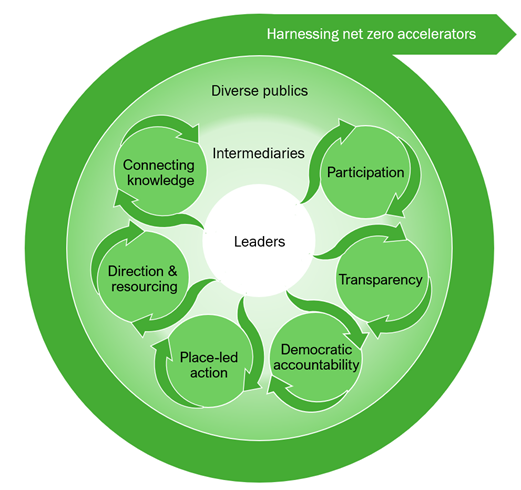
Table 7 provides further detail on each of the governance mechanisms identified, alongside indicative lessons for leaders to support collaboration with intermediaries and publics to harness the accelerators.
5.2 Interactions in and between intermediaries and publics
The boundary between publics and intermediaries is highly permeable. These actors engage in parallel and multi-directional social interactions, market interactions and networks of trust, which can influence their readiness to participate in net zero and wider climate action.
While these interactions are outside the direct control of leaders, they can influence, and be influenced by, governance mechanisms and require careful consideration when leaders shape net zero policies. Table 8 provides indicative lessons for leaders on how deepening their understanding of the role of these interactions in net zero transformations can improve the success of governance mechanisms.
Across the mechanisms and interactions identified, there is a wealth of research, literature and case studies that leaders can draw from, to design evidence-based approaches to increase the pace of progress to reaching net zero.
6. Policy recommendations: how to accelerate towards net zero
There is no one-size-fits all answer to reaching net zero. But every day climate action features in decisions being taken across the UK at all levels of government, in the boards of private companies, in community groups, as well as by individual citizens and consumers. Each decision represents an opportunity to take a step forward rather than sideways or backward.
With UK governance systems creaking under the complexities of delivering on net zero alongside other challenges, there is a risk that the frictions described in this report give rise to a sense of intractability, leading to paralysis.
However, the evidence makes it clear that there is proven public support for action, many case studies of what works, and a desire for the wider benefits of the transformation net zero promises. Taking this positive, forward-looking pathway will require leaders to place an understanding of social and human systems at the heart of decisions on net zero and prioritise good democratic governance.
UK and devolved governments should take the lead by acting on their commitment to improve cross-departmental coordination and drive collaboration at all levels of governance—across places and scales, and with intermediaries and publics. Most specifically, the Clean Energy Superpower Mission Board should lead a comprehensive strengthening of governance across departments and at all levels of society to meet net zero targets.
Combined and local authorities also have a collective responsibility to embed good democratic governance to accelerate net zero action.
More generally, Table 9 gives five strategic priorities, supported by specific policy recommendations for leaders across places and scales. Each strategic priority identifies a starting point for action and their corresponding accelerators. The CCC’s annual progress reports to Parliament provides a means to assess and track progress on these priorities and to understand how governance is accelerating or holding back delivery across policy areas.
Acknowledgements
Lead authors
The following staff from the Public Policy team in the British Academy’s Policy Directorate led on the synthesis of cross-cutting insights and are this report’s lead authors:
Tuisku (Snow) Curtis-Kolu
Policy Advisor, The British Academy
Henry Richards
Senior Futures Lead, The British Academy
We would also like to thank the British Academy policy team that reviewed and supported the report’s development, particularly Dr Molly Morgan Jones, Dr Adam Wright and Chizitera Pennington.
Working Group
The members of our Net Zero Governance Working Group have provided invaluable expertise, feedback and support for our work. The contents of this report have been guided by their advice and insights. Members acted in an individual, not representative capacity, and the views expressed in this report are not necessarily those of each member.
Professor Sarah Birch FBA (from February 2024)
Professor of Political Science, Kings College London
Professor Hilary Graham CBE FBA
Professor of Health Sciences, University of York
Dr Victoria Hurth (until December 2024)
Fellow of University of Cambridge’s Institute for Sustainability Leadership
Professor Andy Jordan FBA
Professor of Environmental Sciences, University of East Anglia
Professor Tim O’Riordan OBE FBA
Emeritus Professor of Environmental Sciences, University of East Anglia
This report has been a collaborative endeavour, involving leading researchers, the British Academy team and policy communities in its development. We would like to extend our thanks to the researchers and participants in workshops, roundtable discussions and reviews who have contributed their knowledge and insights to the Net Zero Governance programme and this report.
The views and conclusions expressed in this report are not necessarily endorsed by individual Fellows of the British Academy, but are commended by the Academy as contributing to public debate.
Annex 1: Net Zero Governance policy programme
The Net Zero Governance policy programme sits within the British Academy’s Sustainable Futures theme, and wider work on environmental sustainability, net zero and environmental policy.
These include a programme on place-sensitive sustainable policymaking (Where We Live Next), International Just Transitions and Supporting leadership in the research sector to progressively embed environmental sustainability into research, innovation and our building and practices. (117)
The British Academy Net Zero Governance programme aims to marshal SHAPE (Social Science, Humanities and the Arts for People, Economy & environment) evidence and research to:
- Clearly articulate why governance matters on net zero;
- Examine how good quality, place-sensitive, multi-level governance can provide the tools to effectively direct, oversee and create accountability for organisations and institutions that have rightly taken responsibility for reaching net zero within sustainable parameters; and
- Support policymakers with practical insights into what they can do to apply good governance principles around net zero delivery, including continuously supporting a research-informed governance system on net zero.
To develop the programme’s evidence base and research it has funded:
- Sixteen discussion papers drawing research initiatives and case studies from across the UK, and
- Engaged over 80 researchers, including British Academy Fellows.
To build in practical insights, we have engaged over 200 stakeholders across SHAPE researchers, policymakers, business and civil society from local to national governance scales through a series of workshops and roundtables, including:
- Two national workshops,
- Two place-based events,
- Six roundtable events,
- Two interdisciplinary knowledge exchange workshops, and
- Regular one-to-one stakeholder engagements.
The combination of the research evidence and the rich discussions convened around it provide the basis for the conclusions presented in this report, supplemented with insights from other British Academy policy programmes and additional insight and context from wider literature. The significant job of assembling these many parts has been led and guided by the programme’s Working Group alongside our team of policy advisers.
Annex 2: Definitions
Language itself is an important cross-cutting consideration for good governance and some of the terms used can provide leaders with helpful ways of describing the challenges they face. The definitions below are intended to indicate how the terms are used in this report, while readers with a deeper interest in the underlying concepts will find a rich literature on each of them.
‘Good democratic governance’ describes the democratic processes and activities concerned with realising a shared purpose, through a clear strategy, with oversight and accountability. In practice, it can have a range of elements, such as establishing feedback loops for knowledge sharing across institutions, setting statutory duties for reporting or co-designing policies with, and accountable to, citizen and residents.
‘Intermediaries’ are organisations, individuals or entities which facilitate transformations and deliver outcomes through performing a range of roles that link different actors and sectors. They are well placed to convene, organise, translate and collaborate across boundaries to progress net zero transformations. (118)
‘Leaders’ in this report refers to those actors across levels of government accountable to publics and government leaders with direct accountability for the design and delivery of net zero commitments. Leaders cover different roles: political leaders might include a Member of Parliament (UK or devolved), a Mayor, or a local Councillor; other policy leaders might include civil servants across all levels of government, with indirect accountability to publics through elected representatives. Leaders outside of government (such as in businesses, communities, civil society) have a role to play, but are not the direct target of this report.
‘Mechanisms’ are regular and recognisable patterns that explain or respond to events. They can be triggered by certain actions (for example, by the actions of leaders). In governance they help guide decisions, even when the exact outcomes, pathways and conditions are unclear. (119)
‘Net zero’ describes a legally binding target to reduce net carbon emissions by 100 per cent compared to 1990 levels by 2050 at the latest, with equivalent or earlier targets set by the four UK nations, most local authorities, cities and swathes of organisations and institutions, representing significant chunks of the economy.
‘Publics’ refers to the plurality of groups of people, including citizens, with varying levels of interest, involvement in and capacity to act on an issue, emphasising that there is no singular public.
‘Transformation’ refers to climate change mitigation that is sufficiently broad, deep and rapid to contribute to fulfilling the goals of the Paris Agreement and which involves a fundamental shift in the trajectory of societal change away from patterns of development that normalise high-carbon ways of living. (120)
There is a spectrum of possible pathways, where sectors, places and people will experience varying degrees of disruption (such as industrial transitions) and benefits (such as warmer homes), depending on their readiness for and vulnerability to the changes and climate impacts.
Endnotes
Summary
- Published