PDF report
Download PDF reportIntroduction
This report presents the findings and conclusions of the British Academy’s Where We Live Next policy programme.
The evidence it presents demonstrates the benefits and challenges of attending to place when creating and delivering policies. The cross-cutting framework it proposes enables national policy to work in place-appropriate ways, cutting through policy silos.
It builds from the problem in the Academy’s previous project, Where We Live Now (2017), which identified that policies often seem ‘place-blind’ and policymakers struggle to give the right level of attention to what people value about the places in which they live and work. While this earlier project examined the role of place on issues of economic growth and productivity, Where We Live Next has focused on another crucial area of public policy: Environmental Sustainability.
Environmental sustainability is attracting significant political and public attention, as the urgency and awareness of the twin crises of climate change and nature loss continues to grow. There are increasing concerns about how we sustainably meet the needs of people and nature. This includes satisfying rising demands for housing, water, renewable energy provision and digital infrastructure, as well as nature recovery. The expectation is that people and places will need to change and adapt to meet these competing demands.
National and devolved governments play a crucial role in developing policy and coordinating interventions that can respond to environmental challenges in place-appropriate ways. The policies decided at national or international scales, must be applied to different spatial and social contexts.
Despite this, the importance of places should not be under-emphasised in national thinking and policy practice. A recent review of the UK government’s UK Government's Green Book, which sets out the guidelines for how to appraise public policies, highlights the importance of place in its recommendations. The review points to an insufficient emphasis on place-based objectives, as well as the need for government departments and other national actors to work more closely and collaborate with local and regional partners (1).
While the draft English Devolution and Community Empowerment Bill and the recently published Pride in Place Strategy present new opportunities and signal a desire from central government to drive local investment and decentralise powers, we are yet to see how it will unfold and impact upon places.
Recognising the wider dimensions of environmental sustainability, the programme has focused on three strands: nature recovery, energy transitions and sustainable homes. In each case, attention has been on the importance of facilitating place-led and spatially appropriate policy interventions that can meet community needs.
The need to develop and deliver more holistic approaches to deliver on environmental sustainability goals has been a key area identified by Where We Live Next. (2), (3) Environmental policies, while often coordinated centrally, are necessarily enacted in a range of differing local contexts where conflicting issues affect diverse places and communities in very different ways. The role of place becomes pertinent and a necessary lens for national governments to consider how they respond effectively and equitably to environmental challenges, in a way that considers how different places will be affected and whether they require more locally tailored policy solutions. Proactive engagement with places is necessary to achieve better impact, capitalising on opportunities for local and regional decision-making and delivery.(4)
Why focus on place?
Many readers of this report will be familiar with the concept of ‘place’ in a policy context. There has been much debate about political agendas, such as ‘localism’, ‘Levelling Up’ and the differential geographical and social effects of major crises like the Covid-19 pandemic.(5) In this context, the meaning of place is often narrowly defined, with a focus on decisions over where and what to invest in. However, place is more than a target location for funding and resources; it demands a philosophical shift in approach that creates opportunities for ‘joined-up’ systems change.(6)
Place is inherently interdisciplinary and multifaceted, with a broad range of definitions and interpretations. The British Academy’s Where We Live Now work explored its meaning, impact on people and relationships and implications for policy through a collection of opinion pieces, case studies, poetry and imagery. This report builds on this, situating place for environmental policy not just in terms of the geographical or physical dimensions of a locality but also emphasising how these geographies are imbued with meaning, incorporating attention to emotions and memories and lived experiences.
In the context of environmental sustainability, place is an important lens through which policymakers can balance the wide-ranging needs of people, nature and the environment in their decisions over how to tackle complex environmental challenges. Policy interventions for environmental sustainability cannot take a one-size-fits-all approach. A coastal village facing rising sea levels, an urban neighbourhood battling air pollution, and a forested region preserving biodiversity each require tailored approaches rooted in their unique geographies, cultures, histories and identities.
The British Academy’s evidence synthesis report, ‘Understanding the role of place for environmental sustainability,’ highlighted that:
Table 1
- Place allows us to recognise that environmental sustainability has many different yet often interconnected dimensions, that the ‘local’ or ‘place-level’ is where environmental changes and impacts are most obviously witnessed and experienced by people.(7)
- Whilst policies need to be coordinated centrally, they are enacted in a range of geographical contexts where there are divergent views on an issue and how it affects communities in different ways.(8)
- Place provides an arena in which to engage with people’s attitudes and behaviours; it offers the potential for a deeper understanding of pre-existing identities and attachments that shape how people see the world.(9)
National governments play a pivotal role in coordinating the response to environmental challenges across the whole country, managing the UK’s compliance with international agreements and facilitating action at sub-national levels. However, the British Academy's Where We Live Now project highlighted the limitations of national government’s ‘place-blind’ policy approach.(10)
At a time when many people feel increasingly disconnected from those who make decisions, place offers a means of reconnection, access to more sensitive and appropriate policymaking, and better outcomes in terms of our individual and societal well-being.(11)
Since publishing, there has been a further decline in trust and confidence in national government and a growing feeling of discontent and political antagonism, making it even harder for policymakers to respond to environmental challenges that were already deeply complex.(12)
The argument that environmental policy should be more ‘place-based’, ensuring actions are coordinated locally and community-led, has been emphasised for several years.(13) However, while there are many examples of ways in which place-based approaches can contribute to the UK’s own environmental policy goals, such an approach is not effective or suitable in every case. It is also not always possible or desirable for national government to decentralise all policy decisions to local communities to manage key environmental challenges, just as it is also not practical for national government to try to engage directly with people in every place at all times.(14)
Environmental sustainability has been the focus of the Where We Live Next programme. However, as the evidence papers that inform this programme make clear, it is important to see this in the context of a range of interconnected policy areas and themes. These include caring, sharing, building capabilities for individual and collective well-being amongst all, and setting the conditions for future generations so that they have the capacities to thrive and prosper.
These foundations and the Academy’s programme point clearly to the need for renewed attention on the role of and linkages between national government in place-based policy. As such, the programme has explored this concept of ‘place-sensitivity’, how it can be understood and proposes an applied approach in the section below.
Methodology
The Where We Live Next programme carried out research and engagement activities to develop the findings presented in this report. Alongside commissioned case study research. The programme conducted a series of regional and national workshops. Four Regional Policy Insight Workshops provided an opportunity to test emerging insights in the context of different places, by convening cross-sector stakeholders, including sustainability and environmental experts working in SHAPE research, local government, government agencies, NGOs, civil society and business communities in four different places (Manchester, Exeter, Cardiff and Glasgow). This was followed by three National Policy Insight Workshops, which provided an additional opportunity to stress-test the policy insights to ensure relevance across the spectrum of environmental sustainability issues. The approach was iterative, innovative and grounded in place. The structure of this final report is meant to convey that spirit and lends itself to dynamic approaches to policy development and implementation as it is taken forward by various stakeholders.
A place-sensitive approach
A place-sensitive approach intends to capture how national and devolved government (and other layers of government without strong connections to place) can play a vital role in facilitating place-focused environmental sustainability policies and outcomes. Place-sensitivity defines a cross-cutting national policy approach to facilitate place-appropriate activity in ways that cut across policy silos.
The approach is underpinned by four key interconnected features: knowledge, language, participation and multi-level partnerships. Attending to these features, national government can formulate policies that are more flexible to different needs and better embedded in place, as well as create points of reflection to strengthen and augment existing place-based activities.
This report is accompanied by four supporting evidence papers, published in our evidence hub, that elaborate on these features. Each paper draws on commissioned case studies as well as insights from a series of regional and national engagement workshops across three policy contexts. The insights in these papers unpack commonalities and differences, highlighting nuances as well as the factors that might be overlooked in the policy process.
Figure 1: Four features of a place-sensitive approach
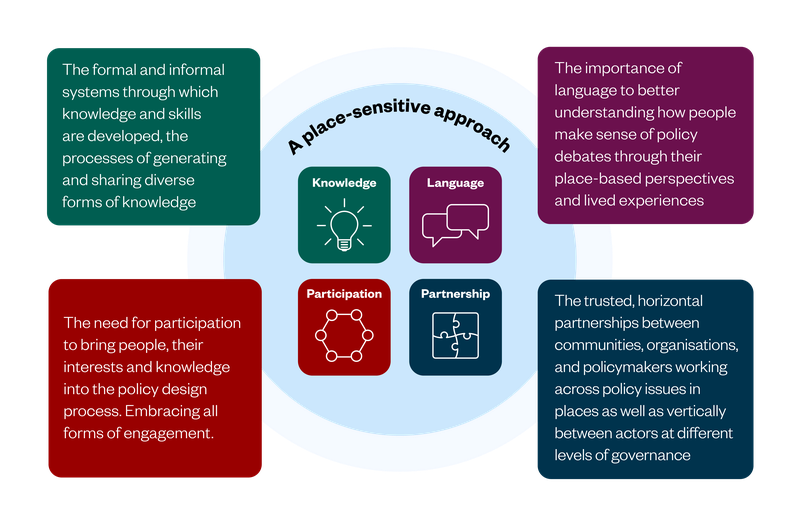
This approach and the four features avoid being prescriptive and benefit from being flexible to a range of interpretations, contexts and places. For example, place-sensitivity in the UK food system may emphasise language, framing and cultural narratives that shape consumer behaviour—from soil and agriculture to body image and health and how this could be better reflected in the UK’s food strategy.(15)
Environmental policy is also largely devolved and complex due to the nature of devolved powers across the UK and the challenges with policy alignment and consistency following Brexit. Policymakers across the four nations will prioritise these features in Figure 1 differently based on the socio-economic and political realities, as well as the divergences in policy approaches and priorities.
Aspects of the approach can be used both in a more bottom-up way by place-based actors to describe their needs and expectations of national government, and as a guide for national government to ensure it is accounting for these needs and expectations.
Adopting a place-sensitive approach
The evidence in this programme has demonstrated that place can enable policymakers to anchor environmental policy and practical efforts in the lived realities of communities and their experience of their local environments. We have heard from policymakers throughout this programme about their desire to develop national policy that responds more effectively to local needs, yet many struggle to know how to adopt more place-sensitive thinking into their work, and what factors to consider in the process.
As of now, policymakers will be considering how to act on the recommendations of the Green Book via the new Treasury taskforce, and it will be crucial that they ensure that place-based business cases sit alongside the natural capital framework in order to support the delivery of environmental sustainability goals. Equally, the implementation of the Pride In Place strategy, through their ‘green neighbourhood’ plans, will need to carefully consider how to ensure these spaces are enabling inclusive and accessible approaches to nature for all community members.(16)
The approach and the four features that are detailed in this report have focused on the policymaking process - from identifying and understanding the challenge, to the activities, actions that are part of developing solutions that help to achieve the intended outcome, recognising the iterative and dynamic nature of the policy process.(17) It should serve as a practical resource for integrating innovative place-centred thinking into the policy profession and its standards framework, helping to strengthen capabilities and upskill policy professionals in ways that support place-sensitive practices at a national level.
To support the application of this approach, we provide starting points that prompt policymakers to consider place-sensitivity throughout the policy cycle — from agenda setting and development to implementation and monitoring. An overview of these starting points is detailed in Table 1.
Acknowledgements
The following staff from the Public Policy team in the British Academy’s Policy Directorate led on the synthesis of cross-cutting insights and are this report’s authors:
Alexandra Paz
Senior Policy Advisor
Dr Clare Stainthorp
Independent Researcher
Henry Richards
Senior Futures Lead
Dr Adam Wright
Head of Public Policy
We would also like to thank the British Academy policy team that reviewed and supported the report’s development, Dr Molly Morgan Jones and Isabelle Taylor.
Working Group
The members of our Where We Live Next Working Group have provided invaluable expertise, feedback and support for our work. The contents of this report have been guided by their expertise, advice and insights.
Professor Jane Wills FBA
Honorary Professor of Geography, The University of Exeter
Professor Susan Owens OBE FBA
Emeritus Professor of Environment and Policy, The University of Cambridge
Professor Tim O’Riordan OBE FBA
Emeritus Professor of Environmental Sciences, University of East Anglia
This report has been a collaborative endeavour, involving leading researchers, the British Academy team and policy communities in its development. We would like to extend our thanks to the researchers and participants in workshops who contributed their knowledge and insights to the Where We Live Next programme and this report
The views and conclusions expressed in this report are not necessarily endorsed by individual fellows of the British Academy, but are commended by the Academy as contributing to public debate
The British Academy’s policy work is enabled by funding from the Department for Science, Innovation and Technology (DSIT). The policy insights and advice that emerge from Academy policy work are independent from government.
Annex 1: Where We Live Next policy programme
The Where We Live Next policy programme is the British Academy’s place-focused programme that sits within its Sustainable Futures theme. The programme has explored the role of place in public policy for environment and climate in relation to housing, energy and nature. Responding to the rising interest in place-based policy interventions, the programme highlights the opportunity and value of place-sensitive policy approaches for transitioning to a more sustainable way of living. It draws on SHAPE (Social Sciences, Humanities, and the Arts for People and the Economy) expertise to highlight why and how existing and future place-sensitive policymaking can be more effective in delivering environmental policy objectives.
Phase 1 – Evidence Gathering
The Academy published an initial report in 2023, Understanding the Role of Place in Environmental Sustainability, which brought together multi-disciplinary SHAPE insights from six commissioned research projects. The approach set out in the report made the case for place and its application to environmental sustainability.
The first set of activities for the programme was to develop a multi-disciplinary evidence base. As part of this, in early 2022, the Academy commissioned six research projects and a piece of social media research that explored various facets of environmental sustainability. The report highlights five interconnected themes that demonstrate the importance of place for environmental sustainability:
- Environmental knowledge and education
- Language and a discourse that resonates
- Long-term trusted and inclusive relationships and partnerships
- Nested governance mechanisms and spaces
- Delegated power and resources
The programme commissioned a further four policy insight case studies to provide a richer nuance and depth to the themes of the Where We Live Next programme, which includes factors of knowledge, education and language, engagement and participation, and voices and scales of governance. These are published on the Evidence Hub, and each is linked directly here:
- People, Place, and Planet. Place-Sensitive Participatory Policy Development for a Just Transition to Net Zero. Tania Carregha and Samanthi Theminimulle. Institute for Community Studies.
- Planning for Future Generations. Dr Yael Lifshitz, Alessandro Di Stefano, Tom Spencer, Emanuela Lipari, Louis Triggs, Gianguido Ghelardi, Jun Qing Bryan Chia, Frederick Taylor; Kings College London
- UK Climate Commissions and Place-Based Climate Action: Evaluating Policies, Governance, Networks and Scales. Dr Andrea Armstrong, Dr Andrew Kythreotis, Dr Candice Howarth; University of Lincoln; Silent Springs Consultants; Place-based Climate Action Network; London School of Economics
- Warmer Homes: How can Grant Subsidy Schemes Improve Engagement with Participants? Kate Betteridge, Francisco Calafate-Faria, Sam Johnson-Schlee, London South Bank University
Phase II: Regional Engagement
Following the release of the evidence report, the programme carried out a series of Regional Engagement Policy Insight Workshops to help build on the evidence of the report and test our research themes against the experiences of people in places across the UK. The programme aimed to provide snapshots from a diverse range of places across the UK, including both rural and urban environments, and perspectives from multiple devolved countries within the UK. The locations for the workshops were:
- Exeter
- Manchester
- Cardiff
- Glasgow
Approach and Methodology
The programme worked alongside existing regional contacts in SHAPE communities (e.g. Fellows of the British Academy, academics, universities and NGOs) to identify appropriate venues and attendees. The spaces in which we delivered the events were directly tied to spaces that the local sustainability projects already had access to. The spaces used in these events included People History Museum, Positive Lights Art Centre, University of Cardiff, and Glasgow Centre for Population Health. The programme worked with Dr. Joanne Tippett, Senior Lecturer of Environment and Development at the University of Manchester, to help design a SHAPE-informed and inclusive workshop approach. Given the nature of the workshop and the range of expertise and sectors represented, we were keen to find an approach that would allow for inclusive engagement that helped to break down silos between individuals and organisations.
National Policy Insight Workshops
After a period of evidence gathering and analysis, the programme conducted its final round of engagement activities in the form of three National Policy Insight Workshops. They created an opportunity for the Academy to engage with national perspectives by convening academics, national policymakers, delivery bodies and relevant national sustainability networks. The events were focused on exploring the broadly applicable framework and policy insights in the context of a specific policy area by grounding the framework in practical policy challenges. The programme tested and refined the policy insights to effectively increase their relevance across the spectrum of environmental and sustainability challenges more effectively. We engaged stakeholders from across nature recovery, energy transitions and sustainable homes topic areas.
Annex 2: Ketso Methodology
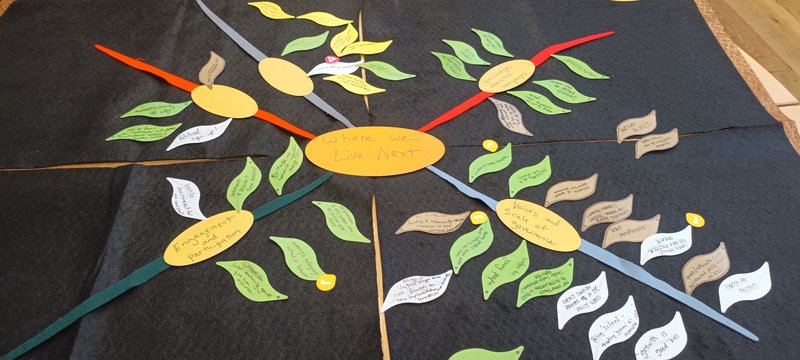
Ketso is a tactile, interactive workshop tool, created by Dr Joanne Tippet, lecturer in Spatial Planning at the University of Manchester. Ketso is based on 25-years of practice and research in 83 countries. Ketso means ‘action’ in Lesotho and it was first used to engage rural communities in planning improvement for their villages. The Ketso kit has multiple functions, but it is used to deliver effective, inclusive and engaging workshops for a range of stakeholders. It provides an easy way to collect insights, structure ideas and clarify priorities and actions.
How it works?
The base of a Ketso kit is a black felt workspace which includes a core centrepiece (the ‘trunk’ of the tree) that is used as the main focus of the workshop.
From the centre piece, there are a range of coloured branches. You can either have the branches already set out prior to the workshop if you have established themes that you would like to explore, or the branches can also come after gathering insights where participants can use the branches to cluster their ideas into themes and find patterns.
Workshops participants in the group are a given coloured leaf-shaped notes which can be written on. At each stage participants will be asked to write or draw their ideas on the coloured side of the leaves before sharing them and adding on to the felt workspace, each leaf is a different colour and can represent a different type of question.
There are also other components that you can incorporate into your workshop like smaller black felt workout spaces that are ideal for breakouts, along with an action grid which can help summarise/prioritise some of the insights from the session.
Example of Ketso felt from Where We Live Next Regional Workshop
Endnotes
Summary
- Published