Mapping SHAPE academic staff
This project examines how the landscape of SHAPE academic staff has changed over time.
Purpose
The British Academy’s Mapping SHAPE project examines how the UK’s SHAPE disciplines are changing across higher education, using interactive data dashboards and analysis. The project aims to help policymakers, academics and those with an interest in UK higher education understand the vital contributions that staff and students in SHAPE disciplines make across the UK’s nations and regions.
This phase of the project focuses on academic staff, analysing trends since 2012/13 to explore how staffing levels vary by subject, region and employment characteristics, and to highlight the wider implications of shifting trends.
This page includes key findings from our analysis, detailed below in three briefings; contextualisation of the changes in a transformative period of policy development; and an interactive map, which tracks changes by institution and by subject over the period.
Key findings
Rise of teaching only contracts has reshaped the UK's academic workforce
- Teaching only staff have increased as the share of joint teaching and research staff has declined
- Research-intensive institutions have seen significant growth in teaching only staff since 2012/13
- Reductions in teaching only staff in the 2024/25 academic year are seen across the UK and across more precarious roles
- Divergent patterns by career stage challenge the relationship between teaching and research
Pathways for early career SHAPE academics are in decline
- Longstanding trends for early career staff are now shifting with a year-on-year decline of 6% in 2024/25, a pattern not seen at more senior levels of academic employment
- The decline in SHAPE is becoming pervasive with early career staff numbers declining in Scotland, Wales and all English regions.
Staff numbers falling in some cold spot areas
- Both staff and student numbers are contracting in cold spot areas for Languages
- Staff in SHAPE disciplines like Linguistics, Classics, and Theology & Religious Studies are becoming concentrated in fewer institutions
- Geographical concentration of staff in Wales is adding to regional imbalance in SHAPE disciplines.
Policy context
Briefings
Given the scale of the data and pace of sector change, the Mapping SHAPE staff analysis briefings are intended as a starting point: to surface patterns, prompt questions and inform priorities for deeper investigation. The three research areas have been chosen to demonstrate the avenues of analysis made possible by our map of staff trends (specifically, changes to employment functions and career stage over time) and to connect staff trends to our analysis of student trends and cold spots from the initial Mapping SHAPE provision work.
- Rise of teaching only contracts has reshaped the UK's academic workforce
- Pathways for early career SHAPE academics are in decline
- Staff numbers falling in some cold spot areas
The briefings are based on analysis of a bespoke HESA dataset, the map (which you can view below) and our own categorisation for subject groups (social sciences, humanities and arts). We have used HESA filters for provider groups (Russell Group, Post-92, and Pre-92; we have labelled pre-92 institutions that are not in the Russell Group as ‘Other pre-92').
Explore the data
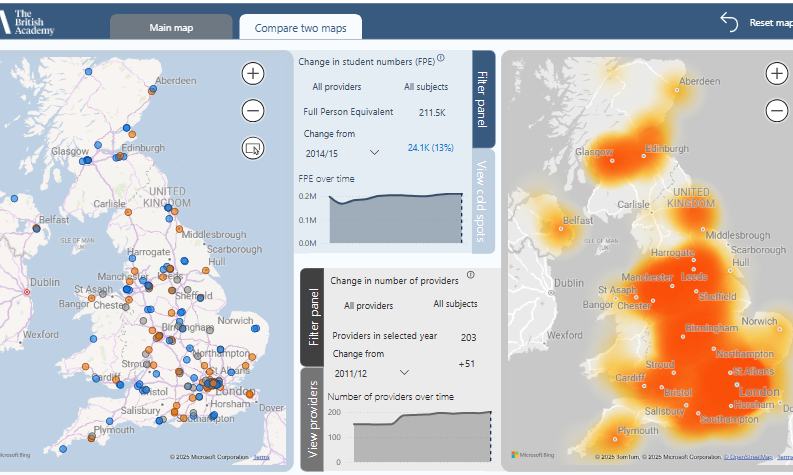
We strongly encourage users to review instructions and explanations about the map below in the 'about the map' section. This provides important information on how to interpret the map and key data definitions for the Mapping SHAPE academic staff project.
The map adds to the range of resources on our SHAPE Observatory. The Observatory brings together the evidence base through which we monitor and communicate the health of our disciplines. It houses resources exploring the pipeline from schools to higher education and beyond, including the skills SHAPE graduates provide in the workforce and the impact of SHAPE research.
This map is best viewed on desktop.