Pathways for early career SHAPE academics are in decline
Mapping SHAPE academic staff briefing
By Dr Joanna Thornborough, Senior Policy Adviser, Pablo Roblero, Senior Policy and Data Analyst and Dr Ruairí Cullen, Senior Observatory Lead
Download PDF briefing- Year
- 2026
Introduction
This briefing examines UK trends in early career academic staff numbers between 2012/13 and 2024/25 across the three broad subject groups of SHAPE – social sciences, humanities and arts – and offers some consideration of the implications of these findings.(1)
Early career academics are in the early stages of their career in higher education teaching and research. Sometimes determined by years post award of their doctorate, this category may also refer to job level, for example, lecturer, research fellow, or teaching fellow. To facilitate succinct analysis, we have aggregated HESA’s career levels into an approximation of four career stages (early career, mid career/established, professor, and senior career), with the caveat that lines between different stages can be much more blurred in real life.(2)
Within the data, there are distinctive patterns in how sector expansions and contractions affect staff at different career stages. While changes have impacted staff at all levels, those at the earlier stages of their careers often experience such trends more sharply. As providers of new talent and expertise, early career academics inject new approaches, paradigms and
methodologies into the UK higher education and research system. Early career roles are the primary pipeline into long-term research and academic employment, shifts in numbers can therefore signal emerging challenges to disciplinary sustainability well before they appear in senior staffing profiles. Tracking these trends is therefore essential to understanding how structural forces, subject health and regional differences are reshaping the academic workforce.
The British Academy has long supported early career academics through our Postdoctoral Fellowship scheme, now in its 40th year. Since 2021, the Academy’s Early Career Researcher network has also offered an inclusive, researcher-led membership body accessible to all UK-based early career researchers working in the humanities and social sciences – regardless of their funding source or background.(3)
Key findings
Longstanding trends for early career staff are now shifting
- Early career staff numbers declined across SHAPE as a whole between 2023/24 and 2024/25, a pattern not seen at more senior levels of academic employment.
- The recent decline has been most notable across the social sciences. These subjects had previously seen strong growth in early career staff numbers since 2020; some of the largest social science disciplines have seen significant decreases in early career staff numbers.
- Where Post-92 institutions were once strongholds for social science disciplines, losses here have been accompanied by growth in early career staff numbers at Russell Group institutions.
- In the humanities, longer-term trends of decline in early career staff are accelerating in disciplines such as History and English Studies.
- The greatest overall long-term decreases in early career staff, however, have been at the individual subject level, particularly within Languages and Area Studies.
- In the arts, sharply contrasting regional trends in early career employment in the UK have become apparent since 2018/19 with numbers increasing in Scotland and London and declining in Wales, the Midlands and sections of northern England.
These trends are becoming pervasive across the UK
- Between 2023/24 and 2024/25, only Northern Ireland, which accounted for just 1% of total SHAPE staff and four institutions in 2024/25, experienced overall growth in SHAPE early career staff numbers.
- No UK region recorded growth in early career humanities staff between 2023/24 and 2024/25.
- Recent declines across SHAPE subjects appear to be particularly affecting North East England and the East Midlands, suggesting the potential emergence of future cold spots for both early career academic employment and subject provision, if the trend holds.
- Post-92 and Other pre-92 institutions have seen longer-term declines in early career humanities staff since 2022/23 but, more recently, declines have also been seen at Russell Group institutions, where humanities numbers had previously been strong.
Longstanding trends for early career staff are now shifting
Over the most recent year of data between 2023/24 and 2024/25, early career academic staff numbers declined across all SHAPE subject areas by 6%, falling from 52,795 to 49,410 FPE.
This decline was more pronounced than for mid career or established staff (-1%) and was not seen at either professor level (a 2% increase) or across senior career roles (which remained stable). This pattern suggests a slowing pipeline of future academic talent and opportunities. For non-SHAPE early career academics, there was a year-on-year growth of 2%.
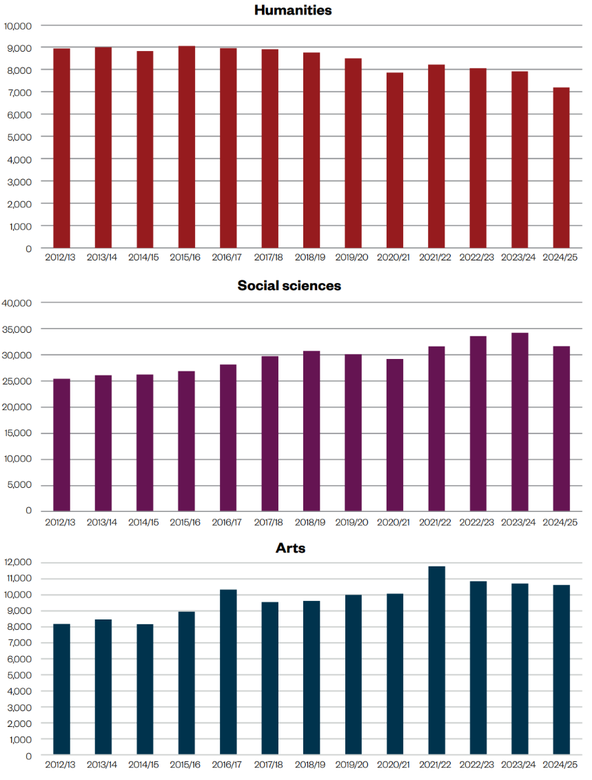
Figure one: Early career academic staff FPE by year in humanities, social sciences and arts, from 2012/13 to 2024/25
Humanities
The humanities as a whole have seen early career staff numbers in broad decline since 2016/17 (-20%), indicating a sustained and systematic challenge for these disciplines. By contrast, early career staff numbers in the social sciences grew by 22% between 2016/17 and 2023/24, and those in the arts by 4% over the same period, prior to the more recent downturn (see Figure 1).
Within the humanities, several subject areas have shown particularly marked long-term decline in early career staff numbers between 2012/13 and 2024/25:
- History -32%
- Classics -30%
- English Studies -19%.
These declines at early career level have been accompanied by stable or slightly increasing numbers at mid career/established and senior levels, and substantial growth at professor level (23% for History, 29% for Classics, and 25% for English Studies), indicating a particularly concerning trend for the future talent pipeline in these disciplines.
As a whole, Languages and Area Studies saw early career staff numbers decline by 21% between 2012/13 and 2024/25. At the individual subject level, the steepest declines are also to be found here:
- French Studies -57%
- Italian Studies -47%
- Spanish and Portuguese Studies -44%
- German and Scandinavian Studies -35%.
Smaller but strategically important languages, such as Russian and Eastern European Studies, have also seen substantial reductions, declining by 32% since 2012/13, including a 25% drop since 2022/23 and the start of the war in Ukraine.
Social sciences
The social sciences had seen the strongest growth in early career staff across SHAPE since 2012/13, particularly from 2020/21 onwards. However, since reaching a peak in 2023/24, numbers have declined sharply, falling by 8% between 2023/24 and 2024/25. With the exception of Development Studies, all social science subjects saw declines in early career staff over the same period. Prior to this, many of these disciplines had exhibited growth in early career numbers. The largest absolute decreases between 2023/24 and 2024/25 were seen in:
- Business and Management (-10%, or -810 FPE)
- Education (-7%, or -410 FPE)
- Social Work (-14%, or -305 FPE)
- and Law (-7%, or -200 FPE).
Apart from in Education, many of these losses occurred at Post-92 institutions, which have traditionally been strongholds for these subjects. A similar pattern was observed for other large social science disciplines between 2022/23 and 2024/25, with significant decreases in early career staff numbers at Other Pre-92 and Post-92 institutions, alongside corresponding increases at Russell Group institutions. In Economics, for example, early career staff numbers at Post-92 institutions declined by 20% while increasing by 17% across Russell Group institutions over the same period.
Arts
Early career staff numbers across the arts increased by 44% between 2012/13 and their peak in 2021/22. This was followed by an 8% decline between 2021/22 and 2022/23. The rate of decline has since slowed and has been less pronounced than in either the social sciences or the humanities. Despite these recent decreases, the number of early career staff in 2024/25 remained 30% higher than in 2012/13.
Across the Performing Arts, early career staff numbers decreased by 8% between 2021/22 and 2024/25. This was largely driven by declining numbers in the Performing Arts: Dance (-21%) and Music (-10%), while Drama remained broadly stable.
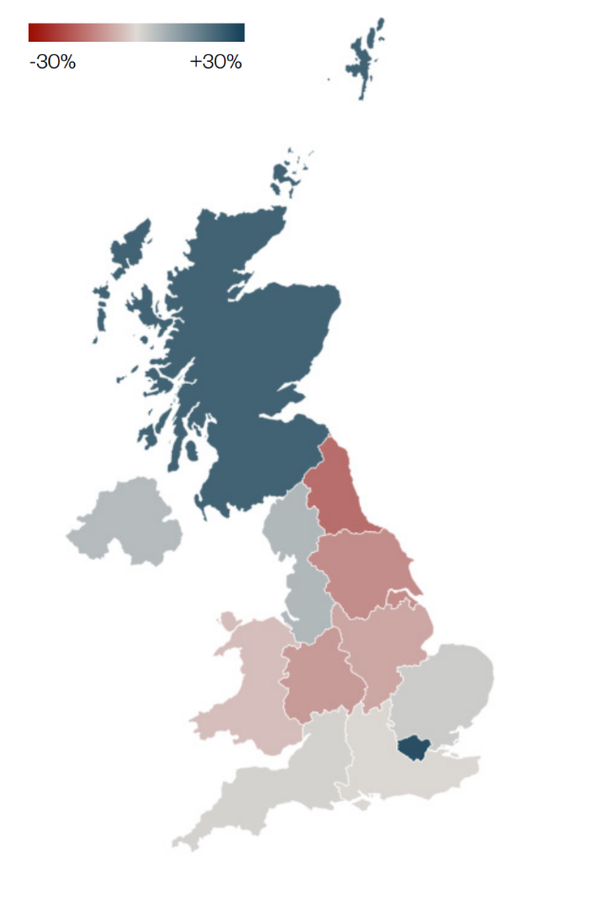
Map one: FPE percentage change in early career academics in arts subjects between 2018/19 and 2024/25, by UK region
Visual Arts (which includes Art, Cinematics and Photography, Design Studies and Others in Creative Arts and Design) experienced a significant drop in early career staff of 11% between 2021/22 and 2022/23, possibly reflecting impacts resulting from the COVID-19 pandemic.
Since then numbers have remained stable. Art has seen a more pronounced longer-term decline, with early career staff numbers falling by 42% between 2012/13 and 2024/25.
Arts subjects play a vital role in supporting the creative industries, which contributed £124 billion to the UK economy in 2023.(4)
The picture for the arts, however, shows strong contrasting regional trends across the UK (see Map 1). Between 2018/19 and 2024/25, Scotland and London saw significant increases in early career staff in arts subjects. Across large parts of the UK, however – stretching from Wales through the Midlands and up the eastern side of England – numbers declined over the same period. Overall changes in arts subjects have typically been driven by developments at a relatively small number of institutions.
Trends are becoming pervasive across the UK
Regions
Between 2023/24 and 2024/25, numbers of early career staff declined or stagnated across England, Wales and Scotland, with particular declines seen in the East Midlands and the North East of England (see Map 2). Northern Ireland was the only UK nation to experience overall growth in SHAPE early career staff numbers in this period, driven by growth in social sciences at a single institution. Northern Ireland, however, accounted for just 1% of total SHAPE staff across four institutions in 2024/25.
Map two: FPE percentage change in early career academics in SHAPE between 2023/24 and 2024/25, by UK region
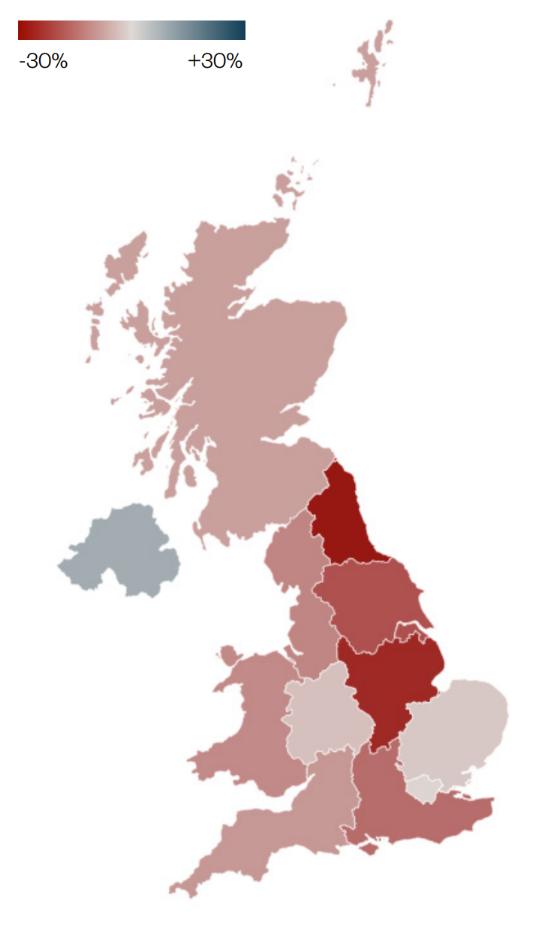
No UK region recorded overall growth in early career humanities staff during this period. The most significant decline occurred in the North East of England, where early career humanities staff numbers fell by 28%, following a growth trajectory of 60% between 2019/20 and 2023/24.
For subjects experiencing particularly sharp declines in early career staff, such as Languages and Area Studies, certain regions stand out as areas of concern. The West and East Midlands and the North East, in particular, have also seen significant reductions in these subjects. Between 2023/24 and 2024/25, early career staff numbers in Languages and Area Studies declined by 24% in the West Midlands, 25% in the East Midlands and 35% in the North East.
Institutions
Declines in early career SHAPE staff were also recorded across all provider groups, including Russell Group institutions, which saw a 4% decrease between 2023/24 and 2024/25. Declines were observed across Russell Group providers in all SHAPE subject areas:
- Arts -13%
- Humanities -8%
- Social sciences -3%.
This represents a reversal of the previous pattern of strong growth at Russell Group institutions, particularly in arts and social science subjects.
Conclusion
Recent broad declines in early career academic staff across SHAPE should be understood in the context of interacting pressures on institutional funding, demand and risk management, as well as the broader policy environment.(5)
Slowing domestic student recruitment in some SHAPE subjects, alongside sharp reductions in international student numbers in others, has constrained fee income at institutional and subject level.
In response, early career and fixed-term roles appear to be the first to be affected by institutional reprioritisation, more quickly than senior or permanent posts. Where disciplines experienced rapid expansion in the years following the COVID-19 pandemic, recent contractions may also reflect short-term recalibration. The concentration of losses at early career level, however, suggests that financial pressures are being translated into decisions that disproportionately affect entry points to academic and research careers, with potential long-term consequences for workforce renewal.
It remains too early to determine whether recent declines in early career staff reflect the beginning of sustained long-term contraction, or a shorter-term recalibration in response to changing patterns of demand and available resources. Where declines have been persistent over time, however, the evidence suggests a more systemic and embedded challenge, posing an immediate risk to the future sustainability of affected disciplines – particularly where this coincides with falling or stagnating undergraduate and postgraduate enrolments.
Declines in early career academic staff matter not only for individual career pathways, but for the long-term health of disciplines and the higher education and research system as a whole.
Early career academics underpin future research capacity, curriculum renewal, and teaching resilience, particularly in strategically important but vulnerable subjects. Many of these subjects feed into and supply the talent needs of vibrant areas of the UK economy, such as the creative industries. Geographic concentrations of decline risk contributing to regional cold spots, reducing student choice and weakening local research and skills ecosystems.(6)
Over time, constrained entry into academic careers may also narrow the uture leadership pipeline, with implications for innovation, economic growth, and the UK’s ability to sustain internationally competitive research and teaching across SHAPE subjects.
Endnotes
Summary
- Published