Staff numbers are falling in some cold spot areas
By Connor Mckenzie, Deputy Head of Policy (Higher Education), Pablo Roblero, Senior Policy and Data Analyst and Dr Ruairí Cullen, Senior Observatory Lead
Download PDF briefing- Year
- 2026
Introduction
This briefing synthesises findings from British Academy analysis of academic staff data with other work on cold spots in SHAPE (social sciences, humanities and arts for people and the economy) provision in the UK. It provides a picture of how the academic workforce in the social sciences and humanities has changed over more than a decade, and how this compares with undergraduate student numbers in areas where cold spots are emerging in provision in the UK. Figures refer to a period from the 2012/13 academic year to 2024/25, and ‘staff’ refers to academic staff, unless otherwise specified.(1)
For this briefing, three areas of focus have been selected to compare staff data with undergraduate student data: (1) Languages, (2) smaller subjects such as Linguistics, Anthropology, Classics, and Theology and Religious Studies, and (3) provision in Wales.(2) Each was identified as an area where provision was shrinking in the report, Cold spots: Mapping inequality in SHAPE provision in UK higher education, published in 2025.(3) We find that all three of the chosen areas show concurrent downward trends in staff numbers in recent years.
Key findings
Languages
- There have been widespread decreases in both staff and students since 2012/13 for French, German and Italian Studies, with relatively consistent long-term downward trends for each subject.
- Similar patterns are observed in all UK nations, suggesting that national higher education policy context is not the primary driver of change.
- In England, the South East and the East Midlands are two regions that appear to be particularly exposed in the fall out from the decline in languages.
Smaller social science & humanities subjects
- Declines in staff numbers in Linguistics, Classics, and Theology and Religious Studies have predominantly occurred since 2018/19. This coincides with an intensification of financial pressures on institutions, particularly in England and Wales.
- The number of institutions engaged in these subjects has decreased, with the main shift being a redistribution of staff by geography and provider group.
- Russell Group institutions have significantly increased teaching-only contracts in these subjects since 2012/13 while the rest of the sector has seen a reduction in staff numbers.
Wales
- Since 2012/13, there has been a significant geographical concentration of students and staff in a limited number of institutions.
- Humanities staff increased by 35% at a single institution, while most other institutions experienced contraction. This reflects the growing concentration of humanities students in the Welsh capital and the expansion of cold spots elsewhere.
- Institutions on the south coast of Wales have increased their share of social sciences staff, largely shaped by growth in early-career, permanent positions. This shows a positive development with respect to workforce precarity and talent pipelines but also points to a growing geographical imbalance in staff capacity across Wales.
Languages
Across UK higher education, the number of staff and students in Languages have contracted. French, German and Italian have experienced the most significant relative declines in staff numbers since 2012/13 of all SHAPE subjects. Spanish remained relatively stable before staff numbers began to decrease in the last six years of data.
These staff trends broadly align with our mapping of UK undergraduate students, which shows declining numbers across most institutions for European languages since 2012/13.
For French, German and Italian, this has been driven by a longer-term decline in aggregate demand, resulting in course and department consolidation within institutions, affecting both staff and students.
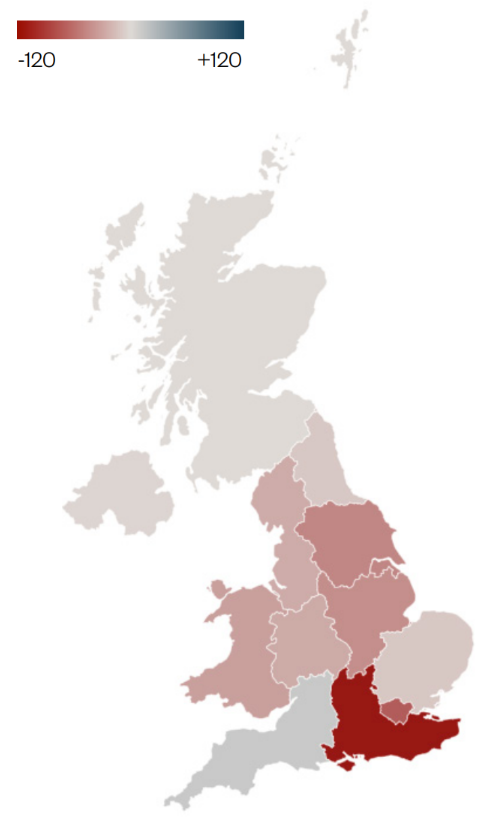
Map one: FPE change in the number of academic staff in French Studies between 2012/13 to 2024/25 by UK region
French
49% of the reduction in French staff since 2012/13 occurred in London and the South East. In these regions, the decline is concentrated among early career staff, particularly those on fixed-term and teaching only contracts. This coincides with parts of the South East becoming cold spots for undergraduate degrees in French over the same period.
Beyond London and the South East, a different regional picture emerges. Yorkshire, the East and West Midlands, the North West and Wales have all seen reductions of between 25 and 50 FPE in staff since 2012/13. In these regions the downward trend also significantly affects staff on teaching and research contracts and those in open-ended, permanent positions. Given the historically small size of language departments, these reductions account for considerable decreases in the capacity of individual institutions.
German
Staff numbers in German and Scandinavian Studies have declined by 35% since 2012/13, with reductions split relatively evenly between early career and mid career/established staff, which differs from wider trends in the staff data. The South East (-40 FPE) and the East Midlands (-25 FPE) experienced the largest declines.
The South East (-40 FPE) is the region which saw the biggest drop in staff numbers in German, followed by the East Midlands (-25 FPE). The South East has had a significant drop (-41%) in student numbers since 2012/13 but still had 55 first year undergraduates taking German in 2024/25. In contrast, the East Midlands has seen student numbers go down from 55 in 2012/13 to no first-year undergraduates under German and Scandinavian Studies in 2024/25. With heavily depleted numbers of staff and students, this places the region at serious risk of a major cold spot in provision emerging.
In the South East, most staff lost since 2012/13 have been on teaching only, fixed-term contracts. Elsewhere, reductions have largely affected teaching and research in open-ended, permanent contracts.
Italian
Staff numbers for Italian Studies have decreased by 32% since 2012/13. Reductions have been concentrated among early career academics in fixed-term, teaching only positions and mid career/established staff on open ended, permanent teaching and research contracts. The South East (-35 FPE) and Wales (-15 FPE) experienced the largest declines. Department sizes for Italian have historically been smaller than for the ‘big three’ European languages (French, Spanish and German), meaning these reductions still represent significant drops in the relative capacity of departments.
The South East has seen student numbers in Italian drop by 49% since 2012/13. In Wales, both student and staff numbers have halved since 2012/13, putting provision in the region in a precarious position. In the East Midlands, staff numbers remained very low between 2012/13 and 2024/25 (dropping from 10 to 5 FPE), while the student cohort dropped to zero. This illustrates how cold spots in provision can emerge even where some academic staff capacity remains.
Smaller social science and humanities subjects
The cold spots report identified smaller subjects such as Linguistics, Anthropology, Classics, and Theology and Religious Studies as vulnerable in different regions of the UK.(4) Each has a relatively small academic staff workforce nationally, each with between 500 and 1,250 staff at any point over the past decade. An inflection point in staff numbers is evident around 2019 for some of these disciplines, after which staff numbers decline more clearly:
- Classics -17% since 2018/19
- Linguistics -14% since 2018/19
- Theology and Religious Studies -10% since 2020/21
This coincides with mounting financial pressures for higher education institutions, particularly in England and Wales. There are some contrasting trends in Scotland for these disciplines – with Classics seeing a decline of -23% since 2018/19, while Theology and Religious Studies (+21%) and Linguistics (+18%) saw a rise in academic staff. In Scotland, student numbers are more controlled by the devolved government which might be one factor influencing diverging trends for smaller SHAPE disciplines, but this requires further investigation. (Numbers for the three disciplines are too low in Northern Ireland for meaningful comparison). Anthropology, another subject with significant cold spots, has had more stable staff numbers with a smaller UK-wide decline of 4% since 2019/20. There was a significant year-on-year decline between 2018/19 and 2019/20 but much of this can be attributed to changes in HESA subject coding taking place that year.
The most striking trend for these subjects is the concentration of staff in certain institutions and the geographical redistribution of staff that results from this. Russell Group institutions have seen significant increases in staff across all four subjects since 2012/13, while the rest of the sector has seen decreases. We can also see the number of institutions with staff in these subjects falling over the period, further concentrating teaching and research capacity within a smaller number of institutions. This leaves the subjects taught and researched in fewer institutions around the UK. In turn, this has contributed to significant regional variation, creating winners and losers across the UK. Given the small scale of these subjects, the withdrawal of provision by a single institution can significantly affect regional capacity and expertise, not just those of the city in which the institution is located.
Figure one: FPE change in staff numbers (FPE) between 2012/13 and 2024/25 for Anthropology, Linguistics, Classics, and Theology and Religious Studies by provider group
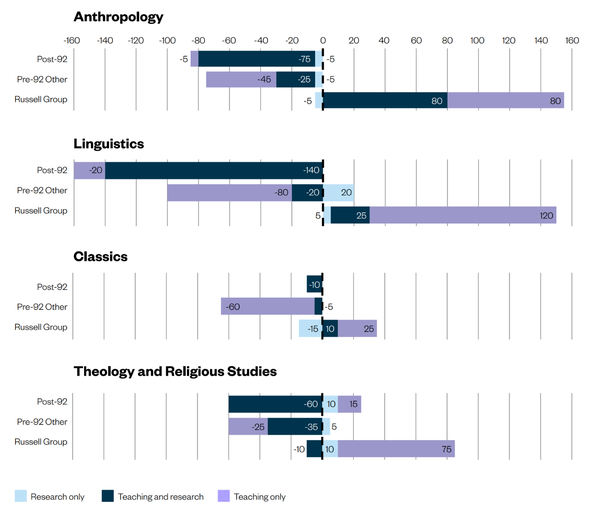
Analysis by employment function shows two clear patterns for these subjects since 2012/13.
This is shown in the bar charts above. Firstly, growth in Russell Group institutions has been predominantly in teaching only contracts (purple). Anthropology differs somewhat from this pattern, with growth occurring across both teaching only and teaching and research contracts.
By contrast, Post-92 institutions have seen substantial reductions in teaching and research staff (dark blue). Even in Classics, where Post-92 numbers were always historically small, a reduction of 10 staff represents a 40% reduction in people. These trends for provider groups by employment function are explored further in an accompanying briefing.
Wales
Wales was identified in the British Academy’s Cold spots(6) report as an area where provision in the social sciences and the humanities is becoming more sparse and less accessible.
Education is devolved in Wales, resulting in a distinct higher education system, though one that closely resembles England’s high fee, demand led model without restriction on student numbers. High levels of student mobility are notable in the Welsh system. In 2024/25, 36% of Welsh students starting their undergraduate degrees studied outside Wales, compared with
around 5% of students from Scotland studying outside Scotland(7). English institutions recruit heavily from Wales, and Welsh institutions also rely partly on recruitment from elsewhere in the UK. As a result, student and staff recruitment in Wales is intimately linked to the fate of institutions in England, especially when competition for students intensifies across the border.
There were 500 more SHAPE academic staff in Wales in 2024/25 than in 2012/13. This overall growth masks considerable variation between the eight institutions operating in Wales.
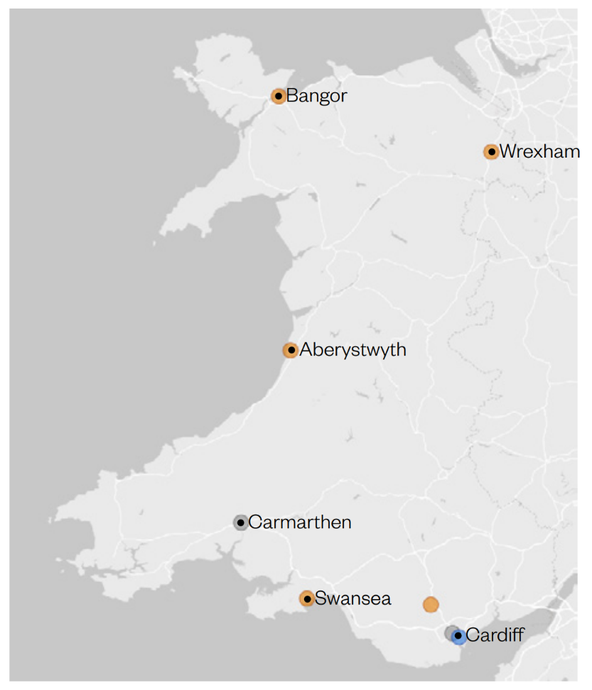
The growth is heavily concentrated in a single institution, Cardiff University, which saw staff numbers increase by 490 (+49%) between 2012/13 and 2024/25.8 This has contributed to sizable geographical concentration of SHAPE staff in the Welsh capital.
The overall increase in SHAPE staff in Wales also masks substantial variation by discipline. While the number of humanities staff at Cardiff University increased by 35% between 2012/13 and 2024/25, staff numbers declined at every other Welsh institution for this subject group, with the exception of the University of Wales Trinity St David:
- In Classics, the number of institutions with either staff or students in the subject has reduced, with cold spots in provision growing across Wales.
- In History, there are three fewer institutions with academic staff and students in 2024/25 than in 2012/13, with particularly sharp declines in Mid and North Wales.
- In Languages, staff numbers declined across most Welsh institutions, leaving provision in a precarious state.
- In Celtic Studies, which includes the Welsh language, staff numbers in Wales have remained stable since 2017/18, though institution numbers have dropped from nine to six over the same period.
The social sciences show a different picture. Institutions on the south coast of Wales have Increased staff numbers since 2012/13, while those in the west and north of the country have declined. Growth in social sciences in the south of Wales has been largely driven by early career and open-ended contracts, bucking UK-wide trends and pointing to reduced precarity in parts of the Welsh academic workforce. Compared to 2012/13, Wales has 880 more open-ended academic posts in the social sciences, and 140 fewer fixed-term posts. Over the same period, we have seen the number of early career professionals in the social sciences increase by 555. This contrasts quite starkly with the humanities workforce in Wales, where there are 200 fewer early career positions than there were in 2012/13.
Map 2.1: FPE change in humanities staff numbers at Welsh institutions between 2012/13 and 2024/25
Map 2.2: FPE change in social sciences staff numbers at Welsh institutions between 2012/13 and 2024/25
Conclusion
Three areas of focus were chosen for this briefing: Languages; smaller subjects in the social sciences and humanities; and Wales. These were all identified as areas of concern in the British Academy’s cold spots mapping project. For all three, there are concurrent downward trends in staff numbers, suggesting that there may be some link between the changes in staff and student numbers. At the same time, there are different patterns emerging in each case.
Institutions are consolidating Languages staff as aggregate student demand has shrunk consistently over the past decade. Student and staff numbers for smaller subjects like Linguistics, Classics and Theology and Religious Studies have reduced, particularly since 2018/19. But the more dramatic shift for this group of smaller subjects is in the overall number of institutions that are engaging with these disciplines, as provision is redistributed towards certain provider groups. One common trend amongst these disciplines since 2012/13 is the significant increases in teaching-only contracts at Russell Group institutions.
In Wales, humanities provision is becoming more concentrated within a single institution as cold spots emerge elsewhere in humanities provision. In contrast, social sciences staff in Wales are becoming more concentrated at institutions on the south coast. However, there has been notable growth in academic posts in the social sciences in Wales in early career positions and open-ended contracts. This is a positive sign for career pathways in these disciplines, and the potential for a shift away from precarity in this part of the sector. Wales provides an interesting case study for the rest of the UK, as a small-scale sector where there are no restrictions on student recruitment that is heavily connected to the English system due to staff and student mobilities.
Endnotes
Summary
- Published
.