Rise of teaching only contracts has reshaped the UK's academic workforce
Mapping SHAPE academic staff briefing
By Dr Joanna Thornborough, Senior Policy Adviser, Pablo Roblero, Senior Policy and Data Analyst and Dr Ruairí Cullen, Senior Observatory Lead
Download PDF briefing- Year
- 2026
This briefing examines trends in staff contract types and their functions between 2012/13 and 2024/25 across the broad subject groups of SHAPE – social sciences, humanities and arts – and offers some consideration of the implications of these findings. (1)
Academic staff contracts are split by employment function into ‘teaching only’, ‘research only’ and ‘teaching and research’. (2)
As data on research only contracts cannot be fully understood without comparing relevant funding data, they are out of scope of this briefing. Joint teaching and research contracts, where a member of staff has their time functionally split between teaching and research, have traditionally been the mainstay of permanent academic contracts.
Policy changes over the past decade, including the structural separation of teaching and research, the removal of student number caps in England and Wales, a declining unit of resource, and the increasing financial pressures across the sector, have all shaped patterns of staff employment.
Key findings
1. Teaching only staff have increased as the share of joint teaching and research staff has declined
- Teaching only staff across SHAPE increased by 49% between 2012/13 and 2024/25, from 31,500 (34% of all SHAPE staff) to 46,890 and 42% of all SHAPE staff.
- While teaching and research staff have grown slightly between 2012/13 and 2024/25, from 52,655 to 53,910, as a proportion of all SHAPE staff, their share has decreased by nearly 10 percentage points from 57% in 2012/13 to 48% in 2024/25, due to strong growth in teaching only staff.
- All but one region of the UK saw growth in SHAPE teaching only staff between 2012/13 and 2024/25.
- The social sciences saw the most sustained growth in teaching only staff between 2012/13 and 2024/25, and grew 60% overall.
- The humanities have seen little longitudinal change in teaching only staff and a decline of 9% in teaching and research staff since 2012/13, though with some variation at subject level.
2. Research-intensive institutions have seen significant growth in teaching only staff since 2012/13
- Institutions in the Russell Group have seen strong growth in teaching only staff, relative to other provider groups, increasing by 129% between 2012/13 and 2024/25.
- Growth has been particularly marked in the social sciences and has coincided with a reduced share of provision in some of these subjects, such as Media, Journalism and Communications, at Post-92 institutions.
- Numbers of teaching only staff declined between 2022/23 and 2024/25 in some subjects, including Classics and Anthropology, at Russell Group institutions, even while the share of taught provision and numbers of students in these subjects continued to increase.
- Stronger overall staff growth at Russell Group institutions is further suggested by a 36% increase in teaching and research staff between 2012/13 and 2024/25.
3. Reductions in teaching only staff are seen across the UK and across more precarious roles in the most recent year of data
- The most recent data for 2024/25 shows declining numbers of teaching only staff across SHAPE (-5%), a pattern long established in the humanities but now also evident in the arts and social sciences, and across almost all regions.
- London and Northern Ireland were the only regions to see growth in teaching only staff between 2023/24 and 2024/25, though they represent opposite ends of the scale in terms of numbers of staff and institutions.
- Declines in teaching only staff were overwhelmingly driven by losses in early career, part-time, fixed-term teaching only roles, which accounted for 47% of total decline.
4. Divergent patterns by career stage challenge the relationship between teaching and research
- Overall growth in teaching only staff has been concentrated among early and mid career/established staff, rather than at senior levels.
- Teaching and research staff have seen the most significant and widespread growth at professorial level, increasing by 36% between 2012/13 and 2024/25.
- Teaching only contracts do not preclude research activity but typically do not support it, limiting opportunities to build a research profile.
- Recent data shows less clearly differentiated patterns emerging across contract type and career stages, which may reflect the effects of financial pressures, course closures and staff losses.
Teaching only staff have increased as the share of joint teaching and research staff has declined
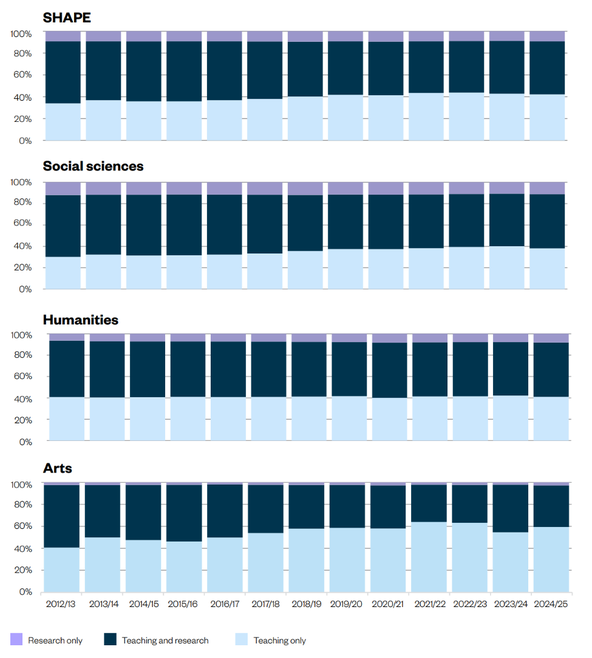
The overall growth in SHAPE academics since 2012/13 has been underpinned by an increase in teaching only staff, which rose by 49% between 2012/13 and 2024/25. Teaching and research staff increased by just 2% over the same period. By comparison, total SHAPE student numbers increased by 23% between 2015/16 and 2024/25.(3)
Although teaching and research staff numbers grew slightly in this period, from 52,655 to 53,910, as a proportion of all SHAPE staff, their share decreased by nearly 10 percentage points from 57% in 2012/13 to 48% in 2024/25. Over the same period, the share of teaching only staff in SHAPE increased from 34% to 42%.
Almost all UK regions saw overall growth in teaching only SHAPE staff between 2012/13 and 2024/25. The strongest growth was seen in Scotland (155%) and the West Midlands (140%).
The only region to see a decline was the South East of England (-19%). UK-wide increases were also seen in non-SHAPE teaching only staff.
Social sciences
The most sustained growth in teaching only staff was in the social sciences, increasing by 75% between 2012/13 and 2023/24, before a 8% decline in 2024/25; despite this dip, total numbers in 2024/25 remained 60% above their 2012/13 level. All social science subjects experienced growth in teaching only staff to 2023/24, with some seeing increases of more than 100%, including:
- Psychology (115%)
- Business and Management (109%)
- Sociology (103%).
Increases in teaching and research staff, by contrast, were more modest.
Humanities
In the humanities, numbers of teaching only staff changed little between 2012/13 and 2023/24, increasing by 3%, before a 7% year-on-year fall in 2024/25. At subject level, there is some variation. For example, between 2012/13 and 2024/25, teaching only staff increased by 25% in Philosophy, but declined by 29% in History. There was also a decrease of 9% in teaching and research staff in the humanities between 2012/13 and 2024/25.
Arts
In the arts, teaching only staff increased by 103% between 2012/13 and 2021/22, before declining by 13% between 2021/22 and 2024/25. This initial growth was in part underpinned by significant increases in Design Studies, one of the largest disciplines in the arts grouping.
The arts also saw the largest reductions in teaching and research staff across SHAPE, with an overall decrease of 20% between 2012/13 and 2024/25. At subject-level, the largest overall decreases were:
- Music (-46%)
- Dance (-44%)
- Art (-40%).
Figure one: Proportion of academic staff by employment function between 2012/13 and 2024/25, by SHAPE and subject group
Research-intensive institutions have seen significant growth in teaching only staff since 2012/13
Much of the increase in teaching only staff has been driven by expansion at Russell Group institutions, which saw an increase of 129% across SHAPE between 2012/13 and 2024/25.
All subject areas in the Russell Group saw growth in teaching only staff, with many increasing by over 200%. The largest increases were in social science subjects:
- Psychology (403%)
- Archaeology (319%)
- Sociology (288%)
- Social Policy (285%)
- Business and Management (269%).
In some subjects such as Archaeology and Anthropology, taught provision remains concentrated in Russell Group institutions. In others, including Sociology and Media, Journalism and Communications, the share of provision at Russell Group and Other pre-92 institutions has increased as that at Post-92 institutions has declined. These shifts coincide with strong growth in international postgraduate taught students from outside of the European Union between 2015/16 and 2023/24.(4)
At subject level at Russell Group institutions, only French Studies (-12%) and Art (-46%) saw overall declines in teaching only staff between 2012/13 and 2024/25. More recently, however, declines in teaching only staff have also appeared in subjects where provision has continued to be increasingly concentrated in Russell Group institutions. For example, teaching only staff in Classics declined by 21% between 2022/23 and 2024/25, while their share of first degree undergraduate students increased slightly by 2 percentage points to 63%. In Anthropology, teaching only staff declined by 17% while the share of first degree undergraduate students increased by 3 percentage points in the same period, to 63%. Both subjects also saw small increases in teaching and research staff at Russell Group institutions of 3% over this period.
In addition to teaching only, numbers of teaching and research staff also increased by 36% across Russell Group institutions between 2012/13 and 2024/25. Here, staff increases were again greatest in the social sciences, with Media, Journalism and Communications seeing teaching and research staff increase by 152%, Development Studies by 123%, and Social Policy by 83%.
Comparing these trends with patterns at Post-92 institutions, teaching only staff increased across most subjects, though there were declines in Languages and Area Studies (-49%), History (-39%) and Linguistics (-26%). Teaching and research contracts, however, declined across the majority of SHAPE subjects, with growth largely limited to the social sciences.
Reductions in teaching only staff are seen across the UK and across more precarious roles in the most recent year of data
More recent data suggests a shift in these trends as between 2023/24 and 2024/25, teaching only staff declined by 5% across SHAPE overall and across all institution types. The decline first appeared in the arts before extending into the social sciences after 2023/24. Between 2023/24 and 2024/25, the most significant declines in teaching only staff were seen in England, specifically in:
- North East (-18%)
- East Midlands (-12%)
- South East (-12%)
- West Midlands (-12%).
London (6%) and Northern Ireland (7%) were the only regions to see growth in teaching only staff in this period, equating to 715 FPE in London and just 30 FPE in Northern Ireland.
The largest single loss was in early career, part-time, fixed-term teaching only roles, which accounted for 47% of total decline and which may represent contracts coming to an end and not being renewed. Early career losses in full-time, fixed-term and full-time, open-ended/permanent contracts accounted for a further 23% of the total decline. Notable teaching only staff losses were also seen at mid career/established level.(5)
Between 2023/24 and 2024/25, teaching only staff in SHAPE also declined across all provider groups. The exception was in the arts at Post-92 institutions, where an 11% increase was primarily driven by growth in Design Studies.
To fully understand the reasons for these changes will require further investigation and contextualisation in light of wider impacts and influences on hiring practices, such as the COVID-19 pandemic and the evolution and clarification of guidance around systems such as the Research Excellence Framework.
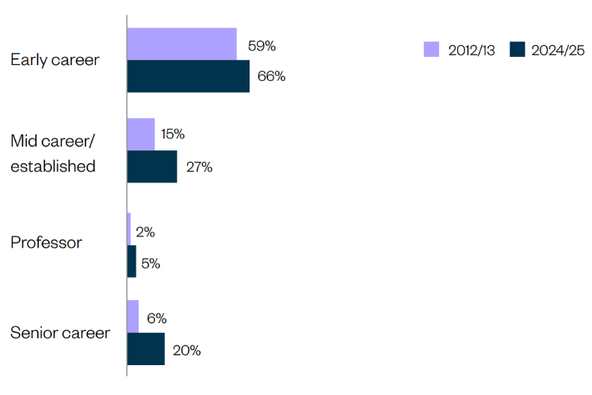
Between 2012/13 and 2024/25, significant and widespread increases in teaching only staff occurred at the early and mid career/established levels.
The total number of early career teaching only staff increased by more than 7,500 FPE in this period, while the share of teaching only staff at early level increased by seven percentage points, from 59% to 66%.
At the mid career/established level, the total increase was over 7,000 FPE, with a 12 percentage point increase in share of teaching only roles, from 15% in 2012/13 to 27% in 2024/25. Increase at the mid career/established level was seen across every UK region in this period.
Figure two: Proportion of SHAPE academic staff in teaching only contracts in 2012/13 and 2024/25, by contract level
Those on teaching only contracts may also be undertaking research activities, but this activity is not typically supported or recognised within workload and traditional progression models.(6)
Under current Research Excellence Framework guidance, research outputs by staff employed on teaching only contracts are also not typically eligible for submission.(7)
Further work is needed to understand how these trends may link to wider concerns about career precarity in the sector.
At early career level, teaching and research roles have declined across many subjects and early career teaching and research staff decreased by 50% overall in the humanities in this period.
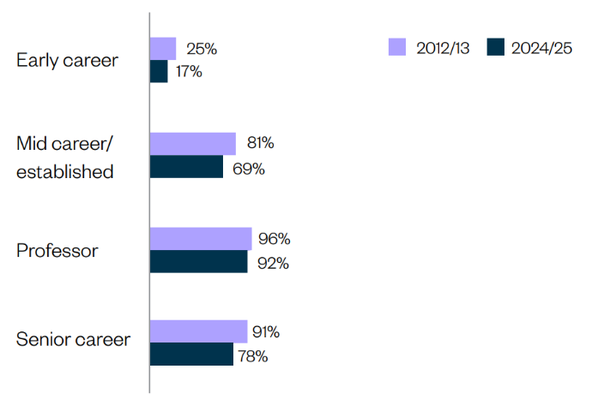
Between 2012/13 and 2024/25, the strongest growth in teaching and research staff was at professorial level. Professors on teaching and research contracts increased by 36%, though the share of professors for this type of contract decreased slightly by 4 percentage points, from 96% in 2012/13 to 92% in 2024/25. This was due to an increase of 3 percentage points in professors on teaching only contracts. Taken together, these patterns raise concerns about the sustainability of research capacity and its international competitiveness, interdisciplinary research, and a healthy future teaching-research nexus.(8)
Where early-career academics are less able to operate across both teaching and research, opportunities to build a research profile may be more limited. Recent data (2023/24 to 2024/25) points to the impact of course closures and staff contractions across many SHAPE disciplines, with declines visible across contract types and career stages; posing a challenge for a more nexus-like relationship between teaching and research. More recent declines in teaching only contracts (-5% since 2023/24) and stability in teaching and research contracts across the humanities and social sciences in this period, however, may indicate that the balance of emphasis between teaching and research is beginning to shift.
Figure three: Proportion of SHAPE academic staff in teaching and research contracts in 2012/13 and 2024/25, by contract level
Conclusion
Trends in the patterns of staff employment point to a gradual, but consequential reconfiguration of the academic workforce in the UK. Over the past decade, teaching only contracts have expanded markedly, while the share of staff on teaching and research contracts has declined. This growth may in part reflect a salutary emphasis by universities on pedagogy. However, this shift weakens the traditional teaching-research nexus and risks limiting both the development of teaching informed by current research and the future pipeline of research-active academics.
That this trend is evident across research-intensive institutions is testament To its pervasiveness and the extent to which developments across the sector have reshaped the academic workforce. Changes in contract types also reflect wider shifts in provision across disciplines and institution types, particularly the contraction of some subject areas within Post-92 institutions. At the same time, the growth of teaching only roles, alongside more modest changes in teaching and research contracts, reflects the increasing reliance on tuition fee income and the influence of student demand on workforce structure. More work is needed to fully understand whether different patterns are occurring in the devolved nations and, if so, why this might be.
Until recently, those at earlier stages of their careers were increasingly employed on contract types that did not facilitate or support research activity. This presents challenges not only for the ideal of activities working together to produce better outcomes for both students and for research, but also for the ability of these academics to develop and sustain their research profiles. By contrast, continued growth in teaching and research contracts at senior levels reinforces the importance of research and of balancing these activities for career progression.
More recent declines in teaching only staff suggest the possibility of a rebalancing. However, these changes are occurring in the context of financial constraint, course closures, and workforce reductions, making it unclear whether they represent a meaningful structural shift or short-term adjustment. Taken together, the evidence points to a sector in transition, with important implications for the future relationship between teaching and research, workforce stability, and for the sustainability and international competitivity of UK research and education.
Endnotes
Summary
- Published