Transcript
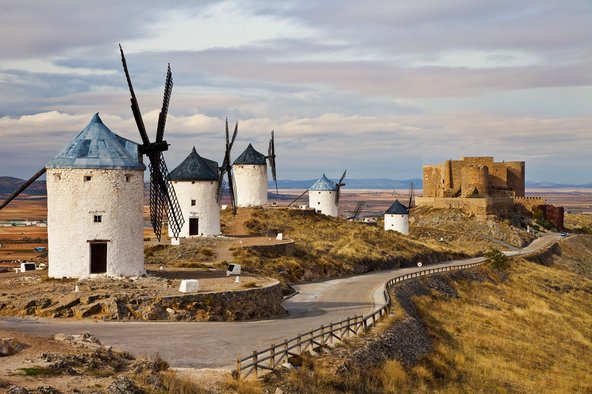
As we explore Miguel de Cervantes' novel, Don Quixote de la Mancha, let me invite you to imagine the rolling plains of La Mancha in early 17th-century Spain, a vast, sun-drenched landscape beneath an open, cloud-dusted sky. Dusty roads link sleepy villages of whitewashed houses; windmills stand like silent sentinels. It's a land where hardship shapes life, yet imagination can transform the ordinary into the extraordinary.
Here, Alonso Quijano, an ageing nobleman, escapes his sterile existence through chivalric romances until obsession tips into madness. He reinvents himself as Don Quixote de la Mancha, self-declared knight errant. Clad in rusted armour and astride his weary steed, Rocinante, he sets out to revive a world of noble quests and damsels in distress, though long vanished.
With his loyal yet sceptical squire, Sancho Panza, he embarks on misadventures. He transforms windmills into giants, inns into castles, flocks into armies, and the peasant girl, Aldonza Lorenzo, into the incomparable Dulcinea.
For Don Quixote sees the world through the vivid hues of imagination, while Sancho, half-believing, half-doubting, navigates the chaos.
This is the story of Don Quixote, Cervantes' ground-breaking novel published in two parts, 1605 and 1615. And it is, as he intended, a comic work. The melancholic is to be made to laugh, and he who is already cheerful, to laugh louder.
Yet beneath its humour lies a profoundly human meditation on dreams, disillusionment, and the blurred line between illusion and reality. The beauty and tragedy of believing in something greater than the world allows, Don Quixote's fantasy collapses. But the tale endures, less timeless than always differently meaningful at different times. Early readers embraced its satire. Romantics saw a tragic idealist.
Nabokov highlighted the novel's cruelty. And more recently, critics have focused on its metafictional complexity and polyphonic voices and its entanglement in Spain's colonial and racial histories. Whether Cervantes critiques or participates in imperial ideologies remains contested, fittingly so for a novel that resists easy answers.
That Don Quijote is, in Harold Bloom’s words, “the central book of Western literature” is rarely disputed. Its legacy runs deep, quixotic ideals, windmill tilt in futility, and literary echoes from Prince Myshkin to Emma Bovary.
The novel echoes through works across media, Richard Strauss's 1897 tone poem, the Broadway musical ‘Man of La Mancha’ from 1965, or Gillian's metafictional cinematic odyssey’ from 2018, ‘The Man Who Killed Don Quixote’. In Madrid, Cervantes is more than an author. He is part of the city's soul.
In April 2014, experts searched for his remains at the Convent of the Barefoot Trinitarians, widely described as a second rescue, echoing his release from captivity in Algiers in 1580.
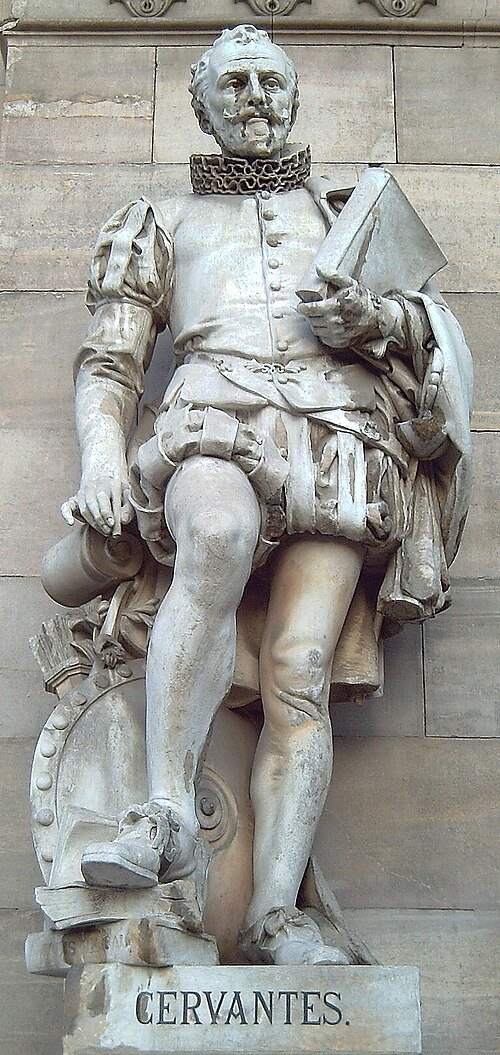
The most iconic tribute, though, stands in the Plaza de España: the Monumento a Cervantes, where the writer gazes toward bronze statues of his knight and squire, and Pablo Picasso's 1955 sketch captures their essence. Quixote, the gaunt dreamer. Sancho, the grounded realist.

I’ve been exploring how lyric isn’t just a genre or a mode, but something more radical: a way of being within literature. A texture. A provocative presence. One that often lives inside other forms. This becomes especially vivid when we think of lyric temporally, its shifting layered sense of time, and becomes especially compelling in the creative practices of imperial Spain. In Cervantes’s novel, the ancient root of poetry—poiesis, the act of “figuring forth”—comes alive in the creative madness. This is where philosophy meets poetics.
Think of Paul Ricoeur, who saw language as a dimension of imagination, or Heidegger, who reimagined poiesis as possibility, an art in which absence, the past, makes ‘presencing’ possible. These ideas, I believe, are key to understanding lyrics force in early modern Spain and how it pulses through Don Quixote.
Now the novel is often praised for blending and reinventing genre, epic, romance, chivalric, picaresque. Bakhtin famously called this the “novelisation” of old forms. But what of its lyric dimensions?
They've been largely overlooked, I think. In his ‘Viaje del Parnaso’, Cervantes writes that heaven denied him the gift of poetry. It's wry, self-aware, and highly revealing. Many have tried to reclaim him as a poet, but these efforts haven't quite stuck. Perhaps the question needs reframing.
Rather than proving Cervantes is a poet through re-evaluating his early verse, his poetic intertext, or citing the 47 intercalated poems in Don Quixote, we might ask what his irony tells us.
As the poet Luis Alberto de Cuenca remarked, Don Quixote revealed Cervantes to be a poeta admirable, or admirable poet, “Even though he didn’t write it in verse.”
So, Cervantes' most profound poetic invention, I believe, lies in his reshaping of reality, a poetic mode that values counter-civilising effect and radical linguistic creativity. What emerges is a pre-Platonic poiesis, where metaphor becomes the original act of non-mimetic signification.
This uncompromising metaphorical engagement allows Don Quixote to transcend the spatial and temporal limits that bind Alonso Quijano, enabling him not just to become, but to know who he is.
Edward Said's shift from origins to beginnings is helpful here, pointing to both the agency of human will and the desire to create meaning. But this very assertion of subjectivity also reveals the fragility of the Quixotic quest, always in tension with systems of power. As Bloom reminds us, it is an erotic quest, where even the eros is literary.
As in Petrarchan poetry, desire catalyses both speech and knowledge. Madness becomes the creative break from silence and from lived reality. From this ‘beginning’, Don Quijote invents what is lived based on what is poeticised.
Paradoxically, although this experience of language reaches back beyond the mnemotechnics of Classical inventio, Dulcinea—his supreme fiction—is formed more from the Petrarchan tradition. But Dulcinea is less character than metaphor and might more appropriately replace ‘windmills’ in Bliss Perry’s definition of the lyric poet: ‘the lyricist cannot help transforming the actual world into his own world, like Don Quijote with his windmills [..] his imagination fastens upon a single trait or aspect of reality, and the resultant metaphor seems truer than any logic.’
Dulcinea is that ‘resultant metaphor’—and her eventual disintegration is the death of the lyric subject. Don Quijote’s belief, and loss of faith in her, is what ultimately leads him to the grave. Though central to the novel’s meta-textual layering, she should not be read as a self-conscious agent, but as the projection of Don Quijote’s idealised self: ‘Ella pelea en mí y vence en mí y yo vivo y respiro en ella y tengo vida y ser’. “And I live and breathe in her and have life and being”.
Dulcinea, like Dante’s Beatrice and Petrarch’s Laura, is a lyric fantasy, not named by chance. All three stand primarily as mental essences but serve very distinct functions. Beatrice, at once beauty and beatitude, saturates Dante’s poetry with a guarantee of significance, a metaphor made meaningful by her historical referent.
Petrarch’s Laura, however, embodying the ambiguity of Rome as eternal city and actual ruin, is a much less transcendent, reliable referent, more polysemic and plural, indicative both of a shifting worldview and Petrarch’s lack of trust in the tethering of the real to the ideal.
Don Quijote’s Dulcinea del Toboso is, as Alcalá Galán reminds us, a more protean entity, collectively and collaboratively constituted in and through the mostly parodic mediation of other voices; but none of these counter configurations make sense without the originary metaphorical ideal that emerges out of Don Quijote having fastened upon the wholly fictional, (im)material peasant girl, Aldonza Lorenzo.
When Dulcinea is “enchanted” in Part II, metaphor falters. The landscape empties of poetry; only the conditions of time and space remain. It signals the beginning of Don Quijote’s decline—and Alonso Quijano’s end.
For ‘Dulcinea’ is the sign that bears the weight and unity of what Don Quijote lived and what is poeticised. Sancho Panza’s attempts to heal the laceration via recuperation of desire in the new poetic mode of pastoral, where everyone but Dulcinea would assume new names, just misses the point.
When Alonso Quijano comes out of lyric being, the collapse is catastrophic. He cannot be persuaded to take to the road again:
yo fui loco, y ya soy cuerdo; fui Don Quijote de la Mancha, y soy agora…Alonso Quijano, el Bueno.
“I was mad, and now I am sane; I was Don Quijote de la Mancha, and now I am Alonso Quijano, the Good.”
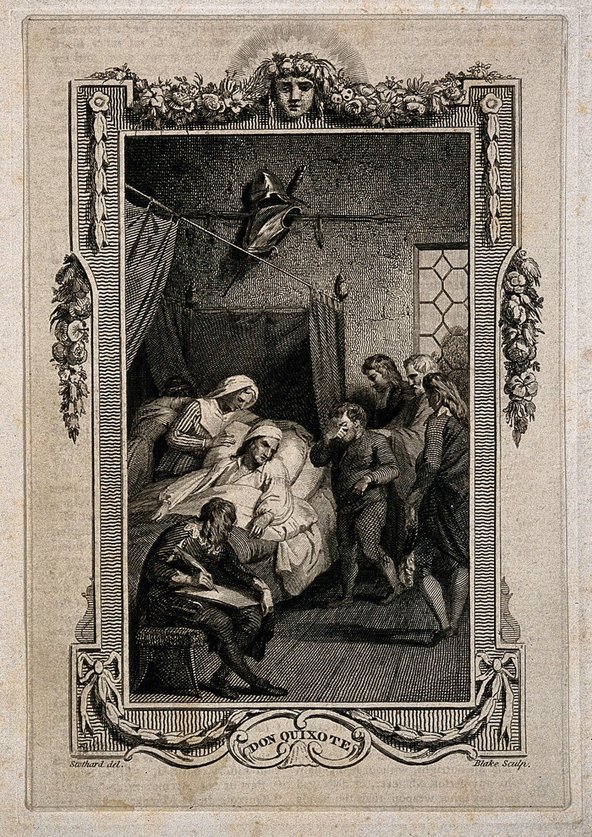
The performance of this final transformation has rightly drawn attention, not least for the inconsistencies that underpin the protagonist's claim to a new type of alternative legacy.
His renunciation of madness and embrace of a Christian death could be read, in Derridean terms, as the new figure of the foreign, the ‘other’, that the protagonist can never properly have, or own, but will embrace and experience nonetheless.
Dulcinea seems to dissipate in this new reality—but in truth, she persists in the act of desengaño, the painful stripping away of illusion. This final chapter is not simply poetological collapse; it is a caesura—a cut in time that compels retrospective re-evaluation.
Across four centuries, Dulcinea’s ‘evolution’ is a formidable reminder of the collapse of the comforting epistemology of Renaissance carpe diem into the darker Baroque vision of memento mori; it is a subjective, imaginative ‘figuring forth’ cast by Cervantes into the ebb and flow of history to challenge public discourse’s claims to unified thinking, and it is now more timely than ever.
Isabel Torres is a Professor of Spanish Golden Age Literature at Queen's University Belfast.
Subscribe to this podcast via your chosen service
This talk is part of the series The British Academy 10-Minute Talks, where the world’s leading professors explain the latest thinking in the humanities and social sciences in just 10 minutes.