Professor Peter Mandler FBA

Modern British history, especially cultural, intellectual and social; the histories of the humanities and social sciences in comparative perspective
Fellow type
UK Fellow
Year elected
2015
Subjects
Education, History

Summary

Peter Mandler is Professor of Modern Cultural History at Cambridge University and Bailey Fellow in History at Gonville and Caius College. His research spans the cultural, social and intellectual history of modern Britain and the histories of the humanities and social sciences in comparative perspective. In the past he has written on ideas of heritage, national history and national character in England, and on the history of the social sciences in Britain and the United States. He is currently directing a project on the experience of universal secondary education in the UK since 1945, funded by the Economic and Social Research Council. His current interests in the history of education and educational policy stem in part from work he has done representing the interests of history and historians in the public sphere, as President of the Royal Historical Society (2012-16), Chair of the Academy's Modern History Section (2018-21), and President of the Historical Association (2020-23).

10-Minute Talks: The crisis of the meritocracy

30 Sep 2020 Professor Peter Mandler FBA

Professor Peter Mandler FBA talks about his new book 'The Crisis of the Meritocracy' and Britain's transition to mass education from WWII onwards.

Current post

University of Cambridge Professor of Modern Cultural History

Gonville and Caius College, Cambridge Bailey Lecturer in History

Publications

The Crisis of the Meritocracy: Britain's Transition to Mass Education Since the Second World War

Peter Mandler - Published in 2020 by Oxford University Press
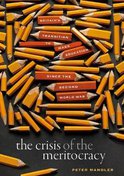
Before the Second World War, only about 20 per cent of the population went to secondary school and barely 2 per cent to university; today everyone goes to secondary school and half of all young people go to university. How did we get here from there? The Crisis of the Meritocracy answers this question not by looking to politicians and educational reforms, but to the revolution in attitudes and expectations amongst the post-war British public – the rights guaranteed by the welfare state, the hope of a better life for one's children, widespread upward mobility from manual to non-manual occupations, confidence in the importance of education in a "learning society" and a "knowledge economy".

Return from the Natives: How Margaret Mead Won the Second World War and Lost the Cold War

Peter Mandler - Published in 2013 by Yale University Press

Celebrated anthropologist Margaret Mead, who studied sex in Samoa and child-rearing in New Guinea in the 1920s and 30s, was determined to show that anthropology could tackle the psychology of the most complex, modern societies in ways useful for waging the Second World War. This fascinating book follows Mead and her closest collaborators – her lover and mentor Ruth Benedict, her third husband Gregory Bateson, and her prospective fourth husband Geoffrey Gorer – through their triumphant climax, when Mead became the cultural ambassador from America to Britain in 1943, to their downfall in the Cold War.

The English National Character: The History of an Idea from Edmund Burke to Tony Blair

Published in 2006 by Yale University Press

What kind of people are “the English”? What characteristic traits and behavior (if any) distinguish them from other people? This highly original and wide-ranging book traces the surprisingly varied history of ideas among the English about their own “national character” over the past two centuries.

History and National Life

Peter Mandler - Published in 2002 by Profile Books
Why do people care about history? It is still casually assumed that the "point" of history is to tell us "who we are". History and National Life, argues that history is less directly "useful", but also richer than that.

The Fall and Rise of the Stately Home

Peter Mandler - Published in 1997 by Yale University Press
How much do the English really care about their stately homes? In this pathbreaking and wide-ranging account of the changing fortunes and status of the stately homes of England over the past two centuries, Peter Mandler melds social, cultural, artistic, and political perspectives and reveals much about the relationship of the nation to its past and its traditional ruling elite.

Aristocratic Government in the Age of Reform: Whigs and Liberals, 1830-52

Peter Mandler - Published in 1990 by Oxford University Press
This book challenges the view that there was a smooth and inevitable progression towards liberalism in early 19th-century England. It examines the argument used by the high Whigs that the landed aristocracy still had a positive contribution to make to the welfare of the people.

The British Academy 10-Minute Talks: The crisis of the meritocracy - why Britain has needed more and more education

30 Sep 2020 The British Academy on YouTube

Peter Mandler talks about his new book 'The Crisis of the Meritocracy' and Britain's transition to mass education from WWII onwards.

Other Fellows of the British Academy

Professor Sir Hew Strachan FBA

European military history of the 19th and 20th centuries, and especially the First World War; modern strategic studies

hew-strachan.jpg

Professor David James FBA

The sociology of education and social inequalities; policy, governance, teaching, learning, assessment, lifelong learning and the education-work relationship.

David James FBA

Sign up to our email newsletters

Join our mailing list to explore the ideas and impact of the British Academy. Get updates on research, funding, policy, international collaborations, and events that bring the humanities and social sciences to life.