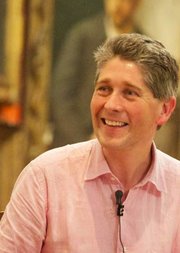
Professor Patrick Haggard FBA
- Fellow type
- UK Fellow
- Year elected
- 2014
- Subjects
- Psychology
- Sections
- Psychology
Summary
Professor Patrick Haggard has two major research themes. The first is the cognitive neuroscience of voluntary action. Experiments in this theme attempt to link the subjective experience of intending and performing manual actions to the brain processes that occur before and after actual movement. The second research theme is the representation of one's own body. How does the brain create and maintain a represention of one's own body as a physical object? How is this representation influenced by current sensory inputs, such as touch and pain? How do such body representations contribute to a sense of self? These questions are addressed both in perceptual experiments, and in measures of brain activity elicited when subjects refer to a cognitive representation of the body.
Current post
University College London Professor of Cognitive Neuroscience
Publications
The Sense of Agency
Edited by Patrick Haggard and Baruch Eitam - Published in 2015 by Oxford University Press
Mental Processes in the Human Brain
Edited by Jon Driver, Patrick Haggard, and Tim Shallice - Published in 2008 by Oxford University Press
Online media
Other Fellows of the British Academy
Professor Naomi Ellemers FBA
Social psychology of organisations: group processes and intergroup relations; social identity; stereotyping and discrimination; diversity and innovation; work motivation and career development; work-life balance and gender in organisations

Professor Gordon Brown FBA
Human memory; decision-making in context; the incommensurability of value; money and happiness; polarisation; relationship between income inequality, conspicuous consumption, and nationalism.

Professor Gerd Gigerenzer FBA
Decision-making under uncertainty; ecological rationality of heuristics; the intelligence of intuition; statistical thinking in health care; risk communication and risk literacy