How can urban nature support fair and effective climate action?
By Dr Leslie Mabon
30 Oct 2025
This blog is part of Living with the Planet season at the British Academy.
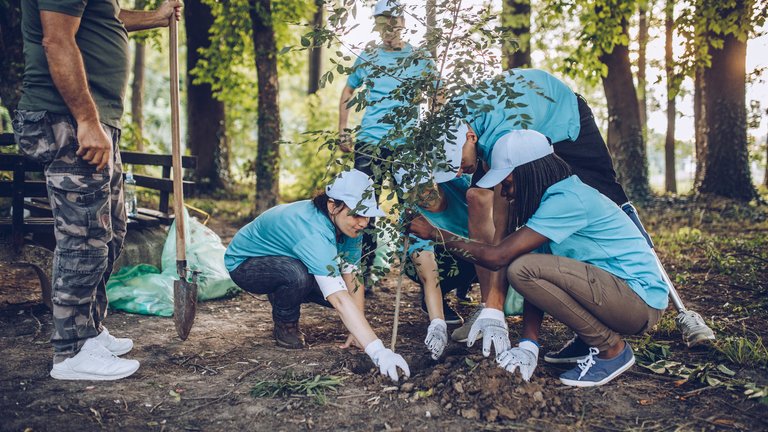
Recent years have seen a flurry of interest in trees, parks, wetlands and many other kinds of nature as a potential response to the multiple climate change, biodiversity protection and sustainability challenges our society faces globally.
Local authorities, national governments, conservation charities and the private sector are all promoting these so-called ‘nature-based solutions’ to counteract the causes and effects of climate change whilst delivering a breadth of contributions to people and wildlife.
In our towns and cities, some of these benefits might include cooling and shading from extreme hot weather, soaking up rainfall and reducing the risk of flooding, or providing spaces of exercise and reflection that can make us better prepared to cope with shocks and stresses under a changing climate.
Not all green spaces are created equal
It is hard to argue against planting more trees, improving parks, or supporting richer habitats for species. However, that doesn’t mean the benefits of nature-based solutions are felt equally across society, or that people will always support actions to enhance nature in their neighbourhood.
Evidence from countries such as the USA and South Africa demonstrates neighbourhoods that have suffered historic discrimination on grounds of race or ethnicity still have less greenery and tree cover decades later. Research from Taiwan too shows that even when the link between deprivation and vulnerability isn’t as straightforward, planning decisions and social factors still have a big influence on who and where is at greatest risk.
In today’s world, through a process known as ‘green climate gentrification’, investments in new trees and green spaces to reduce risks from flooding or extreme hot weather may disproportionately accrue towards wealthier neighbourhoods, leaving the less well-off parts of the city at greater risk.
Even when urban planners and city governments do try to focus their efforts on the most vulnerable people and places, they may face resistance if residents feel that urban nature is being forced onto them or that their concerns have not been listened to.
For that reason, researchers, planners and the public should maintain a healthy dose of scepticism when nature is promoted as a ‘one-size-fits-all’ solution to complex social and environmental challenges.
Bringing fairness into neighbourhood climate action

It is important to remember that natural and semi-natural spaces, if planned and maintained appropriately, can and do reduce harm under a changing and more extreme climate. However, what is crucial is that neighbourhoods are engaged early and fully in the process of planning how their locality can adapt to a changing climate.
In the British Academy-funded project ‘Urban nature for heat-resilient neighbourhoods’, our team at the Open University, along with Scottish climate change charity Verture and National Taiwan University, therefore set out to explore how the support that urban nature provides under a changing climate can be realised, in a way that responds to and respects the perspectives of those living and working nearby.
To do so, we focused on extreme heat as one climate change-related threat for which urban nature has been promoted as a possible countermeasure. Perhaps the most significant and insightful aspect of this project was working with two neighbourhoods in Glasgow, Scotland – Pollok and Govan – which have been assessed as being at high risk from very hot weather, but where the built environment and the greenery within it looks very different.
In cooperation with two local organisations – the Village Storytelling Centre in Pollok and Impact Arts in Govan – we recruited seven community researchers, and trained them in interviewing fellow residents about their experiences of extreme hot weather, as well as their hopes and expectations for how green and natural spaces can support a local response to climate change.
The most pronounced message that came through from both locations was that residents wanted project findings to be available to them longer-term, so that they could use the project outcomes as evidence to support their own community-led actions.
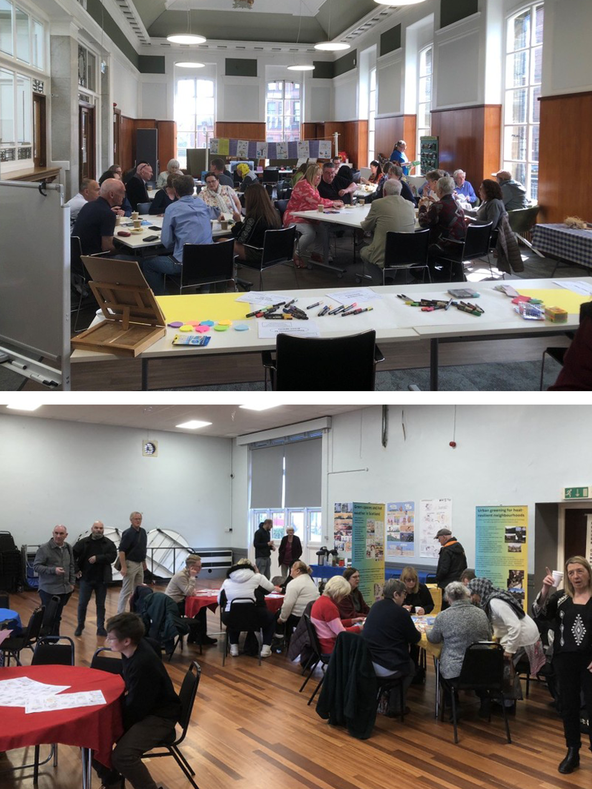
To this end, we organised an ‘evidence café’ in each neighbourhood, where we launched the technical report of everything we’d done together and also shared creative outputs produced by local artists to make our findings more digestible to those from a non-technical background.
We found that both Pollok and Govan are already experiencing the effects of heat – with hotter summers, drier green spaces, and erratic growing seasons – and that cooling and shading from plants and trees is one of many ways residents believe they can adapt to this heat.
However, people in both neighbourhoods talked about the contributions they received from local nature in much wider terms than simply cooling and shading. Rather, we heard a lot about how parks, community gardens and street trees enable wellbeing by supporting community connectivity and organisation, as well as physical and mental health.
Residents of Govan and Pollok were also very aware of wider issues of social justice around ownership of and access to land, and how these factors influenced who – and where – benefited from improvements to the lived environment.
Moreover, as our research shows, a nature-based approach to urban climate change needs to go beyond simply planting ever more trees. Instead, it must also address overarching social and political issues – such as land access and support for public services – which influence who benefits from the nature around them. Tackling these underlying issues is critical to realising processes and outcomes that enable everyone to benefit fairly from living alongside urban nature.
Dr Leslie Mabon is a Senior Lecturer in Environmental Systems in the School of Engineering and Innovation at the Open University. Keep up to date with Dr Mabon on X (@ljmabon), Bluesky (@ljmabon.bsky.social) and LinkedIn.
For more information read the open access review paper produced by the project team, which summarises some of the main contestations and opportunities for reducing heat risk through nature in cities.