Press Release
Sunil Amrith’s "The Burning Earth", an environmental history of the world, wins the £25,000 British Academy Book Prize
22 Oct 2025
“Vivid in detail and beautifully written – important reading for anyone seeking to understand the origins of today’s climate crisis”
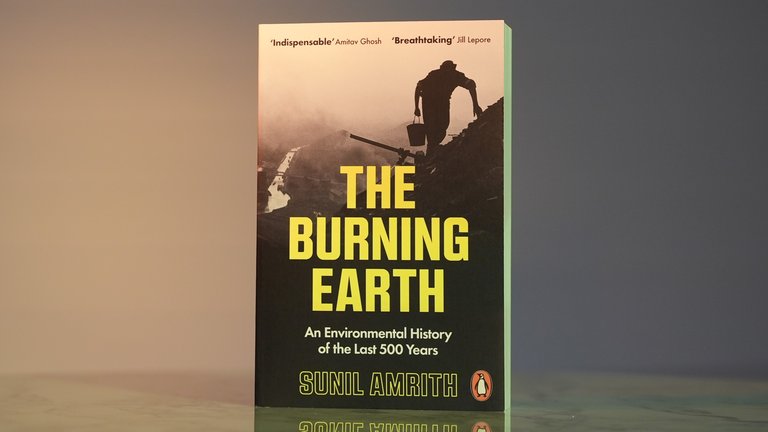
Today, Wednesday 22 October, The Burning Earth: An Environmental History of the Last 500 Years by the historian Sunil Amrith is named as the winner of the 13th British Academy Book Prize.
The announcement was made by Chair of judges Professor Rebecca Earle FBA at a celebration at the British Academy.
In this ground-breaking work of global environmental history, Sunil Amrith explores the connections between human history and environmental change. Drawing on decades of meticulous, eye-opening research, The Burning Earth reveals how colonisation, industrialisation and the shifting patterns of human settlement have not only shaped the modern world but also fuelled the climate crisis we now face today. Spanning continents and centuries – from the conquest of the Americas to British gold mining in South Africa, from the Black Death to the Second World War – Amrith takes the reader on an epic journey, offering a new perspective on humanity’s impact on the planet.
Sunil Amrith is a professor of environmental history at Yale University, and the author of five books. He was born in Nairobi, Kenya, grew up in Singapore, and studied at Cambridge. He now lives in Connecticut.
Commenting on behalf of the judges, Rebecca Earle said: “The Burning Earth is a magisterial account of the interconnections between human history and environmental transformation. It is vivid in detail and beautifully written – important reading for anyone seeking to understand the origins of today’s climate crisis. Amrith is a remarkable scholar whose global perspective reveals the impact of the environment on human history, as well as our impact on the environment. In fact, as he shows, it’s not really possible to separate these two. It is never an easy task to choose one winner from an exceptional shortlist of six, but our panel agreed that The Burning Earth exemplified the spirit of the prize: to deepen understanding of our world.”
Professor Susan J. Smith, President of the British Academy added: “The Burning Earth is a highly readable, timely challenge to everything you thought you knew about the drivers of environmental change across the last 500 years. This fresh look at the interplay of human history with the shape of the earth combines rigorous research with page-turning prose. It is precisely the combination of evidence-informed insight, well-honed ideas, and great writing that we are proud to celebrate through our annual international book prize. On behalf of the British Academy, it is a pleasure and a privilege to congratulate Sunil Amrith on this achievement.”
As the winner of the prize, Sunil Amrith will receive £25,000. Each of the shortlisted writers will receive £1,000. The Burning Earth was chosen from a shortlist of six books that included: The Baton and The Cross: Russia's Church from Pagans to Putin by Lucy Ash; The Golden Road: How Ancient India Transformed the World by William Dalrymple; Africonomics: A History of Western Ignorance by Bronwen Everill; Sick of It: The Global Fight for Women's Health by Sophie Harman; and Sound Tracks: A Musical Detective Story by Graeme Lawson.
Professor Earle was joined on this year’s judging panel by: Professor Shadreck Chirikure FBA, Archaeological Scientist, Edward Hall Professor of Archaeological Science, University of Oxford; the former BBC foreign correspondent Bridget Kendall Hon FBA; Professor Chakravarthi Ram-Prasad FBA, Distinguished Professor of Comparative Religion and Philosophy at Lancaster University; and journalist and broadcaster Ritula Shah.
About the Book Prize
The British Academy Book Prize was established in 2013 to reward and celebrate writing grounded in high-quality research – works of non-fiction that will inspire readers to deepen their understanding of people, society and cultures across time and place. The international prize is open to authors of any nationality. The winner was selected from more than 230 submissions, published between 1 April 2024 and 31 March 2025.
The winner in 2024 was Ross Perlin for Language City: The Fight to Preserve Endangered Mother Tongues.
For media enquiries, please contact: Jane Acton PR
E: [email protected] / T: 07971 661576
Notes to Editors
· Sunil Amrith is available for interview via Jane Acton PR
· To request images please contact Jane Acton PR
· The Burning Earth is published by Allen Lane
· Sunil Amrith is the Renu and Anand Dhawan Professor of History and professor in the School of the Environment at Yale University. He is the author of five books, and a recipient of multiple awards including a MacArthur “Genius” fellowship, the 2024 Fukuoka Academic Prize, and the 2025 Toynbee Prize. He grew up in Singapore, studied at Cambridge, and lives in Connecticut.
About the British Academy Book Prize
· The British Academy Book Prize was established in 2013. It rewards and celebrates the best works of non-fiction based on exceptional research in the fields of the humanities and social sciences. It is part of a wider programme of year-round public events supporting the Academy’s purpose — to deepen and share understanding of people, societies and cultures across time and place, enabling everyone to learn, progress and prosper. The international prize is open to authors of any nationality.
· Previous winners include Ross Perlin for Language City: The Fight to Preserve Endangered Mother Tongues (2024); Nandini Das for Courting India: England, Mughal India and the Origins of Empire (2023); Alia Trabucco Zerán for When Women Kill: Four Crimes Retold (2022); Sujit Sivasundaram for Waves Across the South: A New History of Revolution and Empire (2021); Hazel V. Carby for Imperial Intimacies: A Tale of Two Islands (2020); Toby Green for A Fistful of Shells – West Africa from the Rise of the Slave Trade to the Age of Revolution (2019); Kapka Kassabova for Border: A Journey to the Edge of Europe (2018); Timothy Garton Ash for Free Speech: Ten Principles for a Connected World (2017); Professor Carole Hillenbrand for Islam: A New Historical Introduction (2016), Dr Neil MacGregor for A History of the World in 100 Objects and Germany: Memories of a Nation (2015); Jonathan Jensen for Knowledge in the Blood: Confronting Race and the Apartheid Past (2014); and Karen Armstrong for her writing on culture and religion (2013).
· To be eligible for entry, books must be works of non-fiction published in the UK between 1 April 2024 and 31 March 2025. Authors may be based anywhere in the world and working in any language provided that the nominated work is available in the English language.
· Further information about the British Academy Book Prize can be found here.
#BritishAcademyBookPrize2025