How our Fellowship works
Learn what the British Academy's Fellowship is, how our Fellows are elected and on what basis.
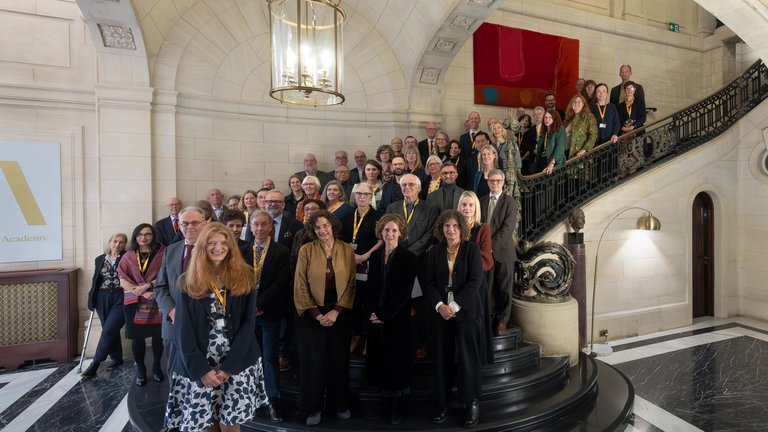
An active Fellowship
Election to the British Academy’s Fellowship is an honorific that recognises the academic distinction that an individual has achieved, but it also means joining an active Fellowship and comes with responsibilities.
Fellows have important roles in the British Academy’s work, including assessing applications for research grants, overseeing and contributing to the British Academy’s policy research programmes, and representing our disciplines nationally and internationally.
Fellows can connect with each other across their disciplines through our series of discussions, seminars, and talks, created for Fellows, by Fellows.
Types of Fellow
Fellows
Fellows are the main category in our Fellowship, comprising over 1,300 academics. An individual must be resident in the UK to be a Fellow.
In addition to Fellows, a smaller number of International Fellows and Honorary Fellows are elected each year.
International Fellows
International Fellows are academics resident outside the UK who have achieved international standing in one or more of the Academy’s disciplines. There are currently over 400 International Fellows.
Honorary Fellows
Honorary Fellows are individuals who have made a significant contribution to the Academy’s mission to sustain and promote advanced research in the humanities and social sciences. They include academics in related fields and individuals whose leadership or philanthropy has advanced our disciplines. There are currently over 50 Honorary Fellows.
Emeritus Fellows
All Fellows retain their Fellowship when they retire as an active Fellow, becoming Emeritus Fellows. Emeritus Fellows no longer participate in the work of the British Academy. Whether a Fellow is active or emeritus is displayed on their webpage.
Criteria on which Fellows are elected
Fellows are elected on their academic achievement in the humanities or social sciences. Neither an individual's country of origin, nor the past or current political situation there are part of the criteria considered when they are put forward for election to the Fellowship – although UK Fellows must be habitually resident in the UK.
Academic distinction
Academic distinction is generally reflected in scholarly research activity and publication, but its definition varies slightly depending on the academic discipline. For example, fieldwork is prized in archaeology, whilst in psychology a person’s achievements in practice can be significant.
In all our disciplines, distinction is defined by the importance of the candidate’s contribution to their field. This can be evidenced by:
- whether their work has changed the field;
- their esteem and reputation within the discipline;
- the significance of their work compared with the work of other British Academy Fellows in that discipline; and
- whether the candidate is credible in comparison to members of other academies’ fellowships and other candidates proposed for election to the British Academy’s Fellowship.
The number of Fellows elected each year
Up to 58 UK Fellows, up to 32 International Fellows and up to four Honorary Fellows are elected each year.
The limited number of candidates each year means that not all academics who achieve distinction in their field are elected to the Fellowship.
As the field of candidates narrows over the electoral process, Fellows may also consider a range of factors, such as gaps in research focus, to support the Fellowship having a breadth of expertise and experience.
How the electoral process works
Nomination
Individuals are nominated and elected to the Fellowship by existing Fellows. It is not possible to apply for Fellowship.
The Fellowship is organised into 21 subject-focused Sections, for example, languages, or economics. Each Fellow belongs to a Section (occasionally, they are members of more than one). Sections are run by Section Standing Committees, one of whose responsibilities is to annually nominate individuals for election to the Fellowship.
Fellows – through their Section Standing Committees – put forward individuals to be considered for election to the Academy’s governance bodies and ultimately to Council, the Academy’s governing board of trustees.
Conflict of interest
Our approach to recusal ensures that elections are conducted with integrity and transparency. Fellows do not take part in proposing, nominating, discussing or voting where a conflict of interest exists.
Assessment and ballot
Candidates must consent to consideration and submit a CV. Section Standing Committees prepare a report on the field of candidates, and after discussion, agree on which candidates should be assessed independently and who the assessors should be.
Independent assessments are sought from scholars of international standing in the candidate’s field. These assessments provide critical external perspectives and inform the Section’s deliberations.
Following review of citations and assessments, Sections vote and meet in March to consider ballot results and make recommendations. Fellows must declare any institutional or personal connections with candidates throughout the process.
Recommendations are forwarded to either the Humanities or Social Sciences Group, which ensures consistency of standards and ranks candidates. These rankings are reviewed by the Fellowship and Structures Committee and then submitted to the Academy’s Council in June. The Council agrees the final list of candidates to be recommended for election at the Annual General Meeting (AGM) in July.
Election results are announced annually in mid-July following the AGM.
Conduct
Although the British Academy is not a public body, nor does it have statutory authority over its Fellows, it is entrusted with public funds and functions for the public good.
Fellows are therefore expected to adhere to the principles of scholarly and professional good conduct set out in our Regulations. These include:
- the Nolan Principles of selflessness, integrity, objectivity, accountability, openness, honesty and leadership for those involved in public service or members of public bodies; and
- the code of the UK Research Integrity Office.
Our bye-laws state that each Fellow must be a “fit and proper person”, which the Academy traditionally interprets primarily in terms of scholarly fitness. Scholarly fitness covers Fellows’ professional conduct in the course of their activities in research; teaching; activities related to their scholarship such as other published writing and broadcasts; and their involvement in the Academy’s Fellowship, governance and programmatic work.