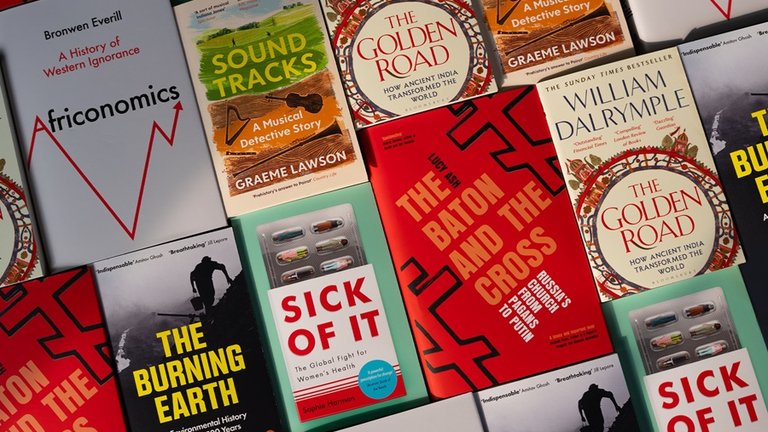
The Baton and The Cross: Russia's Church from Pagans to Putin
By Lucy Ash
2025 shortlisted book

For over a thousand years, the Russian Orthodox Church has endured dramatic shifts in power — from Mongol rule and the tsarist era to Soviet repression and the upheavals of the 1990s.
Today, it once again plays a central role in politics, closely aligned with the Kremlin and supporting Vladimir Putin’s invasion of Ukraine.
In 'The Baton and the Cross', documentary maker Lucy Ash examines how religion in Russia is being reshaped under Putin. She traces how church leaders and political elites use Orthodoxy to promote nationalism, assert cultural dominance, and reinforce state authority.
Drawing on both historical research and reporting, Lucy explores the Church’s influence on daily life across Russia — from city neighbourhoods to remote Siberian villages.
The book also looks at the intersection of faith, politics, security services, and wealth, revealing how this alliance is shaping contemporary Russian society.
About the author
Lucy Ash is an award-winning presenter of radio and TV documentaries.
An expert on Russia and post-Soviet countries she was first sent to Moscow by the BBC in 1990 and has been covering the region's social, political, and cultural issues ever since.
'The Baton and the Cross' is her first book.
The judges on the book
“Power and politics are woven into the history of the Russian Orthodox Church. 'The Baton and the Cross' traces those threads through time, to the modern day and shows how Vladimir Putin has co-opted the church into reinforcing his vision of the country’s social and political identity.
The war in Ukraine is central to this partnership. Using a compelling mix of history and reportage, 'The Baton and the Cross' provides a clarifying prism through which to view Putin’s Russia.”
Interview with Lucy Ash

How do the themes in your book help us to understand societal issues?
Vladimir Putin was an early precursor of the culture wars attacking liberal values. He went against gay rights, abortion and feminism way before Trump was ever in the White House.
I think that he's influenced or inspired by a book that came out under Ivan the Terrible in the 16th century called the ‘Domostroy’, which was basically a book of household rules. It advocated beating up your wife to instil a sense of discipline in her and even beating your servants when they were pregnant, although not too harshly.
What are the biggest assumptions you are hoping to challenge?
One is that the church is independent of the state and a force for good. I wanted to show that down the millennia, the church has always been at the right hand of power, and it's done whatever it takes to survive and sometimes enrich itself, whatever the cost.
Who influenced you when researching your book?
Father Georgi Edelstein, a 90 year old man, had gone against the authorities so many times that he'd been deprived of his church, and he was preaching in a converted sauna at the bottom of his garden.
He refused to condone violence and the war against Ukraine, even when his parishioners sometimes wanted to goad him into it. He was always very steadfast and very brave.
Why is non-fiction important?
It shines a light on subjects that the reader may not be familiar with, may not even know they're interested in, but these are topics that are very important to understanding how the world works.