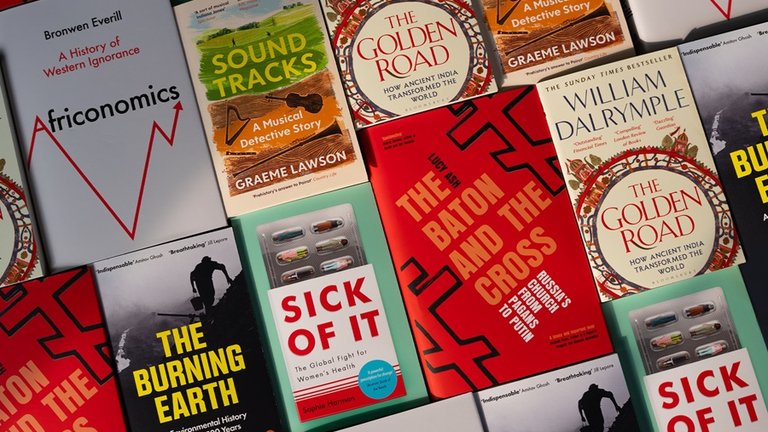
Sound Tracks: A Musical Detective Story
By Graeme Lawson
2025 shortlisted book
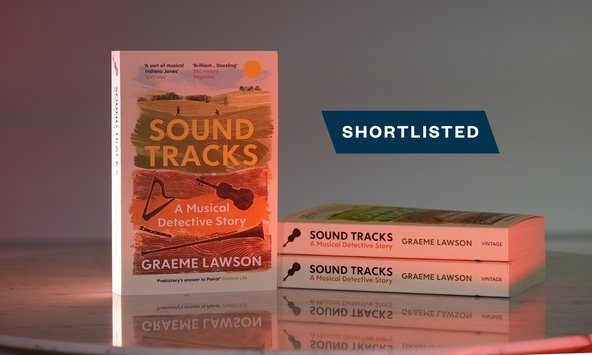
'Sound Tracks' explores humanity’s relationship with music through fifty captivating “detective stories”. Each of historian Graeme Lawson’s chapters takes readers on a journey across time and space, uncovering musical artifacts from archaeological digs around the world.
From ancient caves and tombs to rivers, deserts, and oceans, the book brings the past to life through sound. Readers encounter the playful experiments of a child in 8th-century Peru, the signals of a soldier on Hadrian’s Wall, and the grand resonance of 5th-century BCE bells buried in China.
By examining these discoveries, 'Sound Tracks' shows how music has been central to human life — not only as entertainment or religious expression, but as a way of commemorating, communicating, and shaping communities.
Full of vivid stories and surprising insights, the book offers a fresh perspective on the sounds of the past, revealing the voices and music that have long been lost to history.
About the author
Graeme Lawson is an archaeologist, musician and historian with a lifelong fascination for music’s fossil record.
He has held senior research fellowships at Cambridge and the Freie Universität Berlin, pioneering the application of science to music’s prehistory and tracing musical continuities through time and across continents.
The judges on the book
“Starting in the present and working backward into the deep past, like an archaeological dig, 'Sound Tracks' is a glorious illustration of our long relationship with music.
“Each short chapter focuses on a single archaeological find or set of finds, to show how people have always made music. Graeme Lawson’s expertise in everything from replicating medieval bone flutes, to stringing lyres, brings to life the sounds and significance of our ancestors’ musical worlds.”
Interview with Graeme Lawson

How do the themes in your book help us address social issues?
The world is divided in some ways and very interconnected in others. I think one of the encouraging things to come out of the archaeological study of music is to see the universal appeal that music has always had, going way back to our prehistory.
I'm thinking of the relationship between ancient European musics and ancient pre-Columbian American musics, which are unconnected and yet parallel each other in many interesting ways.
What assumptions were you hoping to challenge?
The idea that music is insubstantial, that it has no materiality of its own. It's often said that it's transitory. Music is in the moment, and after the moment it's gone.
That's not the experience of musicians. Musicians go around with music in their heads all the time. In archaeology, we're dealing with the fossil record of musical instruments from very different periods. To establish the materiality of music has been one of the pleasures of writing this book.
Which instrument most influenced you when researching your book?
The lyre is a more or less extinct instrument today, certainly in Europe, but at one time it was a great instrument of the world.
When we find remains of lyres, fragments of wood and bronze, we're looking at the footprint, not just of lyre music, but also of song and poetry, because they were the quintessential accompaniment to ancient poets.
Why is non-fiction important?
I think one of the great values of non-fiction is its objectivity, the possibility that it brings with it of accountability, in the sense that a non-fiction work can be interrogated, can be followed up, can be challenged.
It encourages critical thinking, in this case, about our deep human past and music's role in that past.