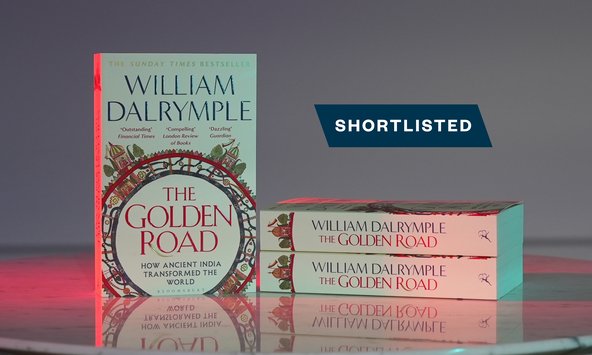
The Golden Road: How Ancient India Transformed the World
By William Dalrymple
2025 shortlisted book
India was once at the centre of a vast cultural and intellectual network that stretched across Eurasia. For over a millennium, the subcontinent exported art, religion, technology, astronomy, music, dance, literature, mathematics, and mythology, influencing civilisations along a Golden Road from the Red Sea to the Pacific.
In this book, historian William Dalrymple highlights India’s pivotal role in shaping the ancient world.
Drawing on decades of research, he traces the spread of Indian ideas — from the largest Hindu temple in the world at Angkor Wat and the spread of Buddhism in China, to the trade that supported the Roman Empire and the creation of the numerals we still use today.
The book shows how India’s innovations and cultural achievements transformed both its neighbours and the broader world, offering a fresh perspective on its enduring influence on history and modern life.
About the author
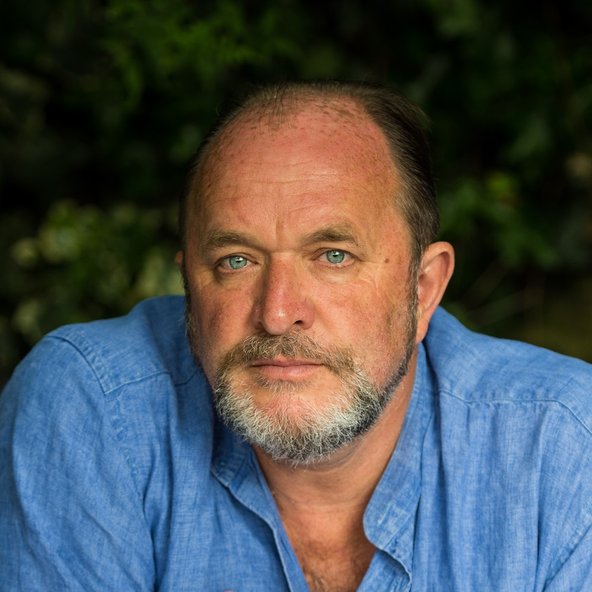
William Dalrymple is a fellow of the Royal Society of Literature, the Royal Asiatic Society and the Royal Society of Edinburgh.
He is the author of the Wolfson Prize-winning 'White Mughals', 'The Last Mughal', which won the Duff Cooper Prize, and the Hemingway and Kapuscinski Prize-winning 'Return of a King'. He has written and presented three television series and is the co-host of podcast Empire with Anita Anand.
In 2018, he was presented with the prestigious President’s Medal by the British Academy for his outstanding literary achievement and for co-founding the Jaipur Literature Festival.
The judges on the book
“In a brilliant display of imaginative synthesis, William Dalrymple brings together areas of scholarship that seldom engage with each other – on classical India, Tang China, 10th century Southeast Asia, the classical Islamic world and Renaissance Europe – to build his powerful case: the influence of Indian science, architecture, art and religious thought created a millennium-long and continent-spanning ‘Indosphere’, whose influence is with us today.
“The book is vivid in detail, lively in description and dazzling in range. It offers us a new way of thinking of global history.”
Interview with William Dalrymple
What assumptions were you hoping to challenge with your book?
The biggest conduit of East-West trade and ideas in history has been the Silk Road. The Silk Road is actually a very recent notion. It was invented by German geographer Baron von Richthofen in the 1870s and only really entered the English language in the 1930s.
We know from Roman trading manuals that they had every port on the Indian west coast and many on the east coast too. From one port alone in Roman Egypt, a great fleet would trade with Kerala, Gujarat, and Sindh. There was nothing like that going to China.
How do you hope your book will be received by readers?
I am very aware that there are two completely different groups of readers, and they will have completely different assumptions.
You have people in the West who know very little about ancient India or its influence. Then you have 10,000s of readers in India who are hugely aware of the importance of ancient India and are furious that people in the West don't know it better.
Who most influenced you when researching your book?
One is an Indian scholar of China called Tansen Sen, who had an extraordinary life, born to Marxist parents in Mao's China. He is one of the great researchers on India's influence on China. Indian Buddhism took over the court of the only woman emperor of China, Wu Zetian, which is extraordinary, interesting and important.
And my friend, Peter Frankopan, whose book ‘The Silk Road’ I'm pushing against in many ways. I know he has very different ideas from me about this, but that made our intellectual wrangling all the more exciting.
Why is non-fiction important?
I see it like a map to guide you through the world. You wouldn't set off across London looking for a good park to sit in if you didn't have a map. In the same way, you can't understand the past.
You can't understand the world around you unless you're informed by good non-fiction. And increasingly, in my middle age, I find myself reading more and more non-fiction.