The Burning Earth: An Environmental History of the Last 500 Years
By Sunil Amrith
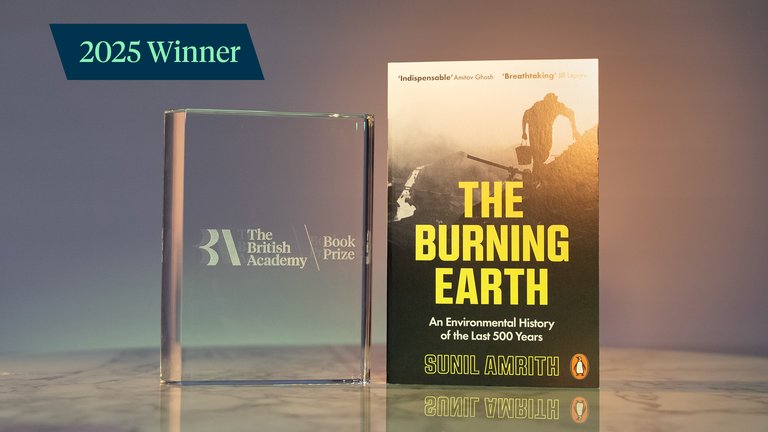
2025 winner
Sunil Amrith was named the 13th winner of the British Academy Book Prize.
Chair of the judges, Professor Rebecca Earle, on behalf of the judging panel said:
The Burning Earth is a magisterial account of the interconnections between human history and environmental transformation. It is vivid in detail and beautifully written – important reading for anyone seeking to understand the origins of today’s climate crisis. Amrith is a remarkable scholar whose global perspective reveals the impact of the environment on human history, as well as our impact on the environment.
In fact, as he shows, it’s not really possible to separate these two. It is never an easy task to choose one winner from an exceptional shortlist of six, but our panel agreed that The Burning Earth exemplified the spirit of the prize: to deepen understanding of our world.
About the book
In this global history of how people have reshaped our planet — and how our planet has shaped human societies — historian Sunil Amrith traces connections between empire, industry, environment, and migration, showing how human ambition and resource use have transformed landscapes and lives across the world.
Drawing on a wide range of sources, Sunil examines examples such as Portuguese silver mining in Peru, British gold mining in South Africa, and oil extraction in Central Asia. He also looks at the railways and highways that opened up new frontiers, and the way both World Wars mobilised not only soldiers but also natural resources.
The book highlights how environmental damage has often driven human migration and how the global pursuit of profit, powered by new technologies and energy sources, has touched every corner of the planet. By weaving together stories of conflict, exploitation, and resilience, Sunil presents a history that raises urgent questions about humanity’s future and its relationship with the Earth.
About the author
Sunil Amrith is the Renu and Anand Dhawan Professor of History and professor in the School of the Environment at Yale University.
He is the author of five books, and a recipient of multiple awards including a MacArthur “Genius” fellowship, the 2024 Fukuoka Academic Prize, and the 2025 Toynbee Prize.
He grew up in Singapore, studied at Cambridge, and lives in Connecticut.
The judges on the book
“By placing the environment at the centre of human history, Sunil Amrith shows clearly that our relationship with the natural world cannot be separated from the history of political power, inequality and justice.
“Sunil's skilful combination of deep scholarship and clear writing, with a focus on individual stories and vivid examples, makes 'The Burning Earth' the sort of book one might call 'urgent' in its attention to the deep historical roots of today’s climate emergency.”
Interview with Sunil Amrith

How do the themes in your book help us address societal issues?
There is no issue more pressing, more urgent and more complicated than the climate crisis, the ecological crisis and the crisis of biodiversity. I hope that historical perspectives will help us to understand how we got to this place and how we can untangle the knot that we find ourselves in.
What assumptions were you hoping to challenge?
My book sought to challenge the assumption that we can write human history separately from our relationship with the more-than-human world, with the rest of nature.
War and violence are at the very heart of the climate and environmental crisis that we're living through. And I think that's important, because we don't talk enough about war and peace when we're thinking about paths through it.
Who most influenced you when researching your book?
My students are a remarkable generation of young minds who are bringing an enormous amount of creativity and commitment to reimagine how we live on this planet and make a viable future.
My conversations with my students, the questions they asked and the insights they came up with are what gave me the confidence to write this book on such a large subject.
Why is non-fiction important?
Non-fiction can appeal to the heart as much as to the head. It can bring the whole breadth of human experiences to readers as they grapple with the largest questions of what it is to be human and how we should live in the world today.