The Tame and the Wild: People and Animals after 1492
Marcy Norton
2024 shortlisted book
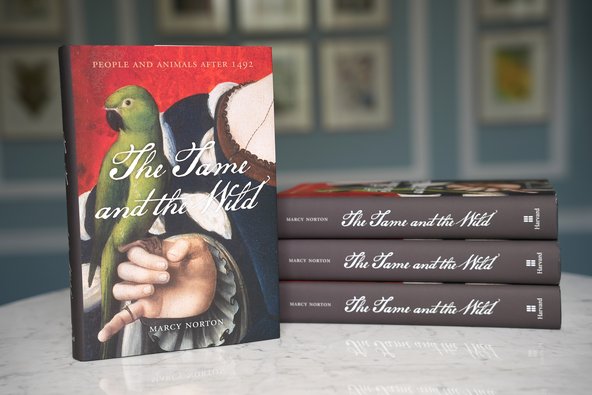
A dramatic new interpretation of the encounter between Europe and the Americas that reveals the crucial role of animals in the shaping of the modern world.
When the men and women of the island of Guanahani first made contact with Christopher Columbus and his crew on 12 October 1492, the cultural differences between the two groups were vaster than the oceans that had separated them. There is perhaps no better demonstration than the divide in their respective ways of relating to animals.
In 'The Tame and the Wild', Marcy Norton tells a new history of the colonisation of the Americas, one that places wildlife and livestock at the centre of the story. She reveals that the encounters between European and Native American beliefs about animal life transformed societies on both sides of the Atlantic.
Europeans’ strategies and motives for conquest were inseparable from the horses that carried them in military campaigns and the dogs they deployed to terrorise Native peoples.
Even more crucial were the sheep, cattle, pigs, and chickens whose flesh became food and whose skins became valuable commodities.
Yet, as central as the domestication of animals was to European plans in the Americas, Native peoples’ own practices around animals proved just as crucial in shaping the world after 1492.
Cultures throughout the Caribbean, Amazonia, and Mexico were deeply invested in familiarisation: the practice of capturing wild animals – not only parrots and monkeys but even tapir, deer, and manatee – and turning some of them into 'companion species'.
These taming practices not only influenced the way Indigenous people responded to human and nonhuman intruders but also transformed European culture itself, paving the way for both zoological science and the modern pet.
About the author
Marcy Norton is Associate Professor of History at the University of Pennsylvania and the author of the award-winning 'Sacred Gifts, Profane Pleasures: A History of Tobacco and Chocolate in the Atlantic World' (2008).
Marcy Norton interview

The British Academy Book Prize celebrates books that champion global cultural understanding. What does it mean to you to be shortlisted for such a prize?
I was delighted and very honoured to learn about my nomination for the British Academy Book Prize.
In The Tame and the Wild, I conclude that contemporary factory farming is far from a universal or natural way for people to interact with other animals. In order to see that this ecologically and socially horrific arrangement was not inevitable – nor needs to endure – requires comparative histories of human-animal relationships.
So, it was wonderful to have my book recognised by the prize committee for contributing to “global cultural understanding.” I could not be more pleased!
What was the motivation for writing this book and how does it help readers gain a better understanding of global culture?
I was baffled by this paradox: On the one hand, we know that, in aggregate, animals today suffer more than at any point in history. Consider the billions (!) of animals who lead tortured lives in confinement and then are slaughtered for human over-consumption, and the others who die because of human-caused climate change, water pollution, deforestation, and so on.
And, yet, on the other hand, so many of us have pets whom we adore and consider family members.
So, I wanted to understand how we got here. I think my book illuminates global culture because it shows that certain arrangements that many of us take for granted – such as animal agriculture – are not the only systems devised by human ancestors.
Other ancestors, such as those in Native America, created systems that emphasised our kinship and interdependence with other rather than ideas of hierarchy and difference.
What surprised you the most when researching and writing the book?
A big part of the story I tell in my book is about how Indigenous people throughout South America and Mexico practiced familiarisation – the process of capturing and taming individual wild animals with the objective of making them into family members.
I was amazed at the dazzling variety of species chosen for this purpose. That there were many parrots and monkeys is probably not surprising, but I was astounded by the many other species – tapir, peccary, deer, rattlesnakes, lizards, owls, possum, sloths --- even manatee – to name a few!
What is one key thought or theme that you hope will stick with readers once they’ve finished the book?
I want people to understand that – from a historical as well as ethical perspective – there is nothing natural or inevitable about our current system of animal agriculture.
When we look beyond a Eurocentric horizon, we see that it is equally “natural” for humans to recognise other animals as our cousins as it is to see them as objectified livestock.
It might be useful for Westerners to internalise the Indigenous Amazonian perspective that we should not eat whom we feed.