Smoke and Ashes: Opium's Hidden Histories
Amitav Ghosh
2024 shortlisted book
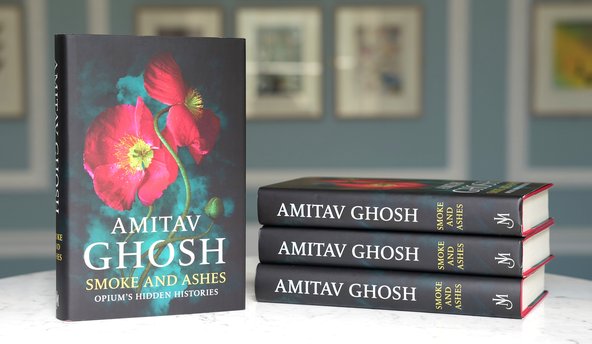
'Smoke and Ashes' is at once a travelogue, a memoir and an excursion into history, both economic and cultural.
Ghosh traces the transformative effect the opium trade had on Britain, India and China, as well as on the world at large. Engineered by the British Empire, which exported opium from India to sell in China, the trade and its revenues were essential to the Empire’s survival.
Upon deeper exploration, Ghosh finds opium at the origins of some of the world’s biggest corporations, several of America’s most powerful families and institutions, and contemporary globalism itself. In India, the long-term consequences were even more profound.
Moving deftly between horticultural histories, the mythologies of capitalism and the social and cultural repercussions of colonialism, 'Smoke and Ashes' reveals the pivotal role one small plant has played in the making of the world as we know – a world that is now teetering on the edge of catastrophe.
About the author
Amitav Ghosh was born in Calcutta, and grew up in India, Bangladesh and Sri Lanka; he studied in Delhi, Oxford and Alexandria.
He is the author of several acclaimed works of fiction and non-fiction including 'The Shadow Lines', 'The Glass Palace', 'The Hungry Tide', the Ibis Trilogy (comprising the novels 'Sea of Poppies', 'River of Smoke' and 'Flood of Fire'), 'Gun Island', 'The Great Derangement', 'The Nutmeg’s Curse', 'Jungle Nama' and 'The Living Mountain'.
Amitav Ghosh’s work has been translated into more than 30 languages. He has been awarded and felicitated across the world.
In 2019, Foreign Policy magazine named him one of the most important global thinkers of the past decade. The same year, the Jnanpith Award, India’s highest literary honour, was conferred on him: he was the first English-language writer to receive it.
Amitav Ghosh interview
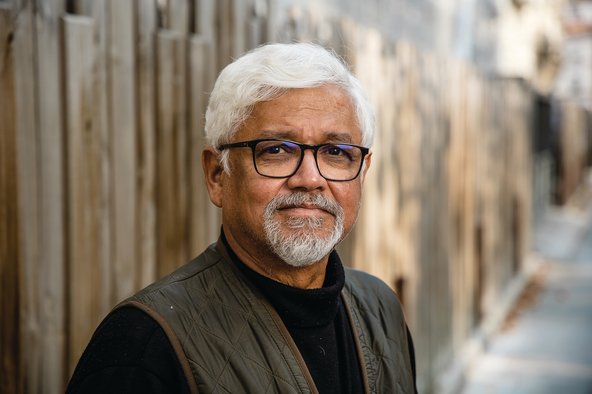
The British Academy Book Prize celebrates books that champion global cultural understanding. What does it mean to you to be shortlisted for such a prize?
News of Smoke and Ashes being nominated for the British Academy's Book Prize fills me with immense gratitude and excitement.
The Academy is a storied institution, and it is a great honour to be included in this extremely distinguished shortlist. This recognition underscores the importance of exploring the entanglements between human history and the planetary environment, a theme central to the book.
What was the motivation for writing this book and how does it help readers gain a better understanding of global culture?
Smoke and Ashes grew out of the research for my trilogy of novels, Sea of Poppies, River of Smoke and Flood of Fire. In writing these books I discovered that the opium trade, a seemingly distant historical event, casts a long shadow on our world.
Understanding this history is crucial for grasping the intricate web of power and dependency that continues to influence our lives today.
What surprised you the most when researching and writing the book?
The most startling revelation was the extent to which the opium trade was foundational to the modern world.
From the rise of industrial capitalism to the formation of nation-states, the impact of this illicit trade is pervasive. It was also shocking to uncover the degree to which this dark chapter of history has been systematically erased or minimised.
What is one key thought or theme that you hope will stick with readers once they’ve finished the book?
I hope readers will carry with them a heightened awareness of our interconnectedness as a global community.
The opium trade serves as a stark reminder of how the actions of a few can have far-reaching consequences. It is essential to recognise the complex legacies of colonialism and capitalism if we are to build a more just and sustainable future.