Material World: A Substantial Story of Our Past and Future
Ed Conway
2024 shortlisted book
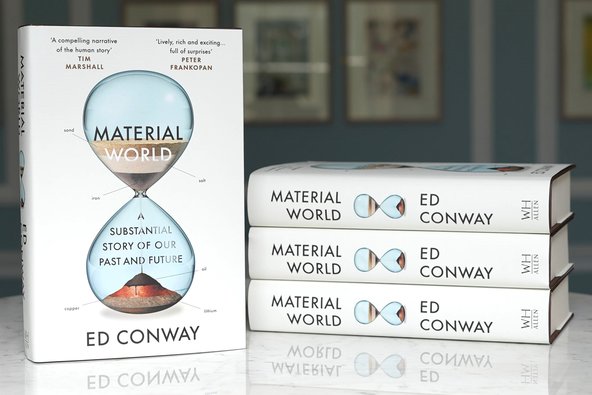
Salt, Iron, Copper, Oil, Sand and Lithium. The struggle for these tiny, magical materials has razed empires, demolished civilisations, fed our greed and our ingenuity for thousands of years.
But the story is not over.
We are often told we now live in a weightless world of information but in fact we dug more stuff out of the earth in 2017 than in all of human history before 1950. And it's getting worse.
To make one bar of gold, we now have to dig 5000 tons of earth. For every tonne of fossil fuels, we extract six tonnes of other materials - from sand to stone to wood to metal.
Even as we pare back our consumption of fossil fuels we have redoubled our consumption of everything else.
Why? Because these ingredients build everything. They power our computers and phones, build our homes and offices, print our books and packaging.
Our modern world would not exist without them, and the hidden battle to control them will shape our future.
About the author
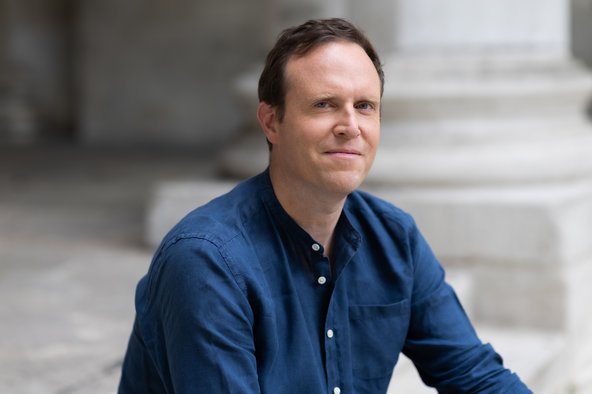
Ed Conway is the Economics and Data Editor of Sky News and has been a regular columnist for the Times and the Sunday Times.He has won numerous awards for his television and newspaper journalism, among them the 2018 Wincott Foundation Journalist of the Year Award.
He is the author of the critically acclaimed book on Bretton Woods, 'The Summit: The Biggest Battle of the Second World War – Fought Behind Closed Doors' (Little, Brown, 2014) and the bestselling '50 Economics Ideas You Really Need to Know' (Quercus, 2009).
Ed studied at Pembroke College, Oxford and the Kennedy School of Government, Harvard University, where he was a Fulbright scholar and a Shorenstein Scholar.
Ed Conway interview
The British Academy Book Prize celebrates books that champion global cultural understanding. What does it mean to you to be shortlisted for such a prize?
I am utterly delighted and honoured. My hope in writing Material World was to underline that all of us, in every part of the planet, are dependent on certain materials – often sourced from vulnerable parts of the world, sometimes at great cost to locals and their environment.
Managing this process is an enormous economic, scientific, political and cultural challenge – so I’m especially grateful the British Academy Book Prize has chosen to highlight it by shortlisting my book.
What was the motivation for writing this book and how does it help readers gain a better understanding of global culture?
It began with a suspicion that the stories we tell ourselves about the world we inhabit are not quite right. We believe we live in an ever more dematerialised world, where intangible things like ideas and apps are far more important than the stuff we dig and blast from the ground.
That’s reinforced by economic statistics like Gross Domestic Product which append a very low value to simple physical products like steel or cement or sand and a high premium for services like social networks or AI.
But those services couldn’t function without these materials. The internet couldn’t happen without fibre optics and fibre optics are essentially made of glass - which in turn is made from sand. Something similar goes for AI, which depends on semiconductors made from silicon.
Everything we touch - every pound of GDP - depends on stuff we dig and blast and refine from the ground. Along the way we displace people from their homes; we create untold carbon emissions and other pollution. Yet this perspective on our civilisation is often ignored.
What surprised you the most when researching and writing the book?
I found myself constantly amazed and disturbed throughout the process. Perhaps above all else, it was the scale of the devastation it takes to extract minerals from the ground and turn them into everyday products.
Everything you touch every day involves the deployment of vast amounts of energy and, almost certainly, large amounts of carbon emissions.
It involves the use of techniques which date back centuries - even something as seemingly advanced as a silicon chip. It involves disruption to human lives and often damage to health. Yet because this stuff is mostly happening on the other side of the planet we’ve made it very easy not to think about it.
But by ignoring the realities of what it takes to construct the world around us - from our physical environment to the food we eat - we forget the compromises. One unexpected upshot of this is we underestimate the scale of effort and disruption it will take to achieve all those climate goals we’ve set ourselves.
What is one key thought or theme that you hope will stick with readers once they’ve finished the book?
I hope they end the book feeling, in the best possible way, conflicted. The logic of the Material World is that it will be hard - harder than most people assume - to reduce our carbon emissions.
But by the same token history shows we humans are amazing at overcoming these kinds of challenges. Perhaps the key lesson is that we are, in some senses, no different to our ancestors going all the way back to the stone age.
Since time immemorial, humans have sought to extract rocks from the earth and turn them into tools that improve their lives. The semiconductor is, in this sense, merely the latest incarnation of this perpetual “stone age”.