Language City: The Fight to Preserve Endangered Mother Tongues
Ross Perlin
2024 winning book
Ross Perlin was named the 12th winner of the British Academy Book Prize.
Professor Charles Tripp, on behalf of the judging panel, said:
"Language City is a fascinating, captivating social history and contemporary linguistic account of New York City.
"It offers readers a unique perspective of the city that brings out both the precarity but also the resilience of migrants and their rich and varied languages as they seek to adapt their native tongues to 21st century urban life.
"At a time when many languages worldwide are disappearing, Ross Perlin celebrates the subtleties of linguistic diversity, treating each with sensitivity and humanity."
About the book
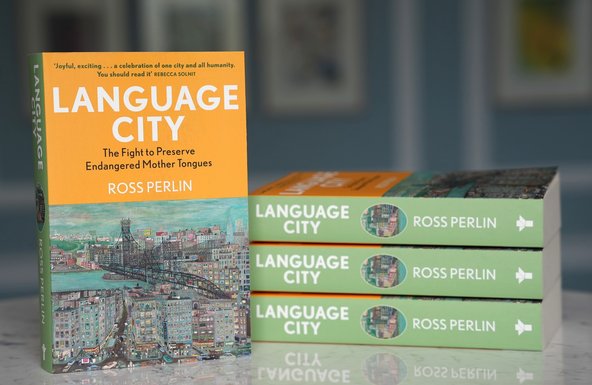
'Language City' offers a portrait of contemporary New York City through six remarkable yet ordinary speakers of little-known languages.
Perlin recounts the unique history of immigration that shaped New York and dives deep into these six speakers’ communities to learn how they are maintaining and reviving their languages against overwhelming linguistic loss.
Perlin also invites us to a fascinating tour of unusual grammars, rare sounds, and powerful cultural histories from all around the world.
Half of all 7000-plus human languages may disappear over the next century and – because many have never been recorded – when they’re gone, it will be forever.
Seke is spoken by 700 people from five ancestral villages in Nepal, 100 of whom have lived in a single Brooklyn apartment building. N’ko is a radical new West African writing system now going global in Harlem and the Bronx.
After centuries of colonisation and displacement, Lenape, the city’s original indigenous language and the source of the name Manhattan ('the place where we get bows'), has just one fluent native speaker, bolstered by a small band of revivalists.
Also profiled in the book are speakers of the indigenous Mexican language Nahuatl, the Central Asian minority language Wakhi, and the former lingua franca of the Lower East Side, Yiddish.
A century after the anti-immigration Johnson-Reed Act closed America’s doors for decades and on the 400th anniversary of New York’s colonial founding, Perlin raises the alarm about growing political threats and the onslaught of 'killer languages' like English and Spanish.
Both remarkable social history and testament to the importance of linguistic diversity, 'Language City' is a joyful and illuminating exploration of a city and the world that made it.
About the author
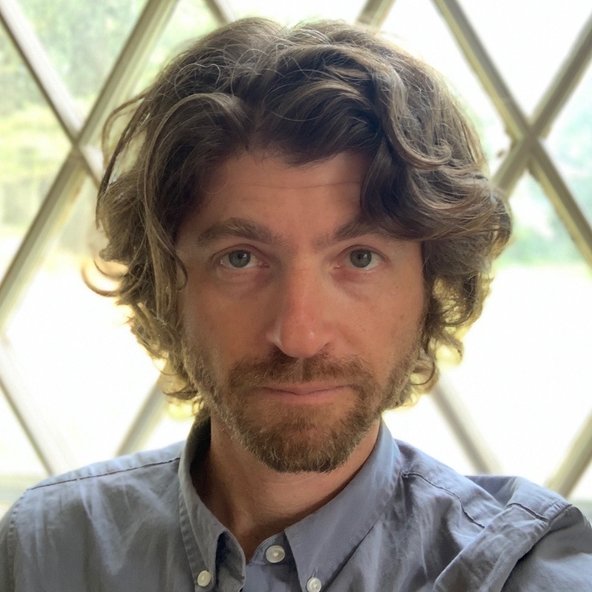
Ross Perlin is a linguist, writer, and translator. Since 2013 he has co-directed the Endangered Language Alliance, a non-profit dedicated to documenting Indigenous, minority, and endangered languages.
He has written for the New York Times, the Guardian, Harper’s, and n+1, and the Endangered Language Alliance has been covered by the New York Times, the New Yorker, BBC, NPR, and many others.
He is also the author of 'Intern Nation: How to Learn Nothing and Earn Little in the Brave New Economy' (2011). Perlin was a New Arizona Fellow at New America and is a native New Yorker.
Ross Perlin interview
The British Academy Book Prize celebrates books that champion global cultural understanding. What does it mean to you to be shortlisted for such a prize?
I’m thrilled that my book Language City, which is all about the deep linguistic diversity of today’s cities, has been shortlisted for the British Academy Book Prize for Global Cultural Understanding— a unique award that could not be more resonant or timely.
What was the motivation for writing this book and how does it help readers gain a better understanding of global culture?
As a linguist at the Endangered Language Alliance, I’ve been involved in the fight for linguistic diversity for over a decade. I’ve worked closely with the six language defenders I profile in Language City, who come from communities all over the world that may be new to most readers.
To understand global culture, we have to look at languages, and in particular at the endangered, Indigenous, minority, and primarily oral languages that make up the majority of the world’s mother tongues. They represent thousands of natural experiments: ways of seeing, understanding, and living that define what it is to be human—and they’re evolving fast in the face of contemporary challenges. The dominant languages not only get all the attention, but are unrepresentative in so many ways. To understand how immigration, urbanisation, and diasporisation are shaping cultures everywhere today, we need the lens of language.
What surprised you the most when researching and writing the book?
The deeper I went, the more I found myself exploring a striking paradox—that language loss may be accelerating worldwide, with half of all 7000-plus languages now considered endangered, but at the same time more and more of those languages are arriving in cities. Never before have cities like New York and London (but many smaller cities as well) been as linguistically diverse as they are today. But the new urban linguistic diversity could diminish fast, before we've even had a chance to recognise, document, or protect it.
What is one key thought or theme that you hope will stick with readers once they’ve finished the book?
Language is an index of time spent with people. It’s not just a code to crack, or a string of sounds that can be automated, translated, broken down, but the ever-evolving expression of a set of relations. Of course, transmitting information is part of what language does, but much more is at stake in terms of our individual and collective identities. I also think it’s crucial to hear the languages themselves in the original as much as possible and to grapple with the linguistic features—not just lexical but phonological, morphological, syntactic and so on—that make languages distinct and shape us in untold and often unimaginable ways.