Waves Across the South: A New History of Revolution and Empire
Sujit Sivasundaram
2021 winning book
Sujit Sivasundaram was the winner of the 2021 British Academy Book Prize.
Professor Charles Tripp, on behalf of the judging panel, said:
Waves Across the South is a riot of ingenuity, a truly powerful and new history of revolutions and empires, re-imagined through the environmental lens of the sea.
The jury was spellbound by Sivasundaram’s skill in combining compelling story-telling with meticulous research. Even as a work of world history it speaks directly to the politics and military interventions of today.
About the book
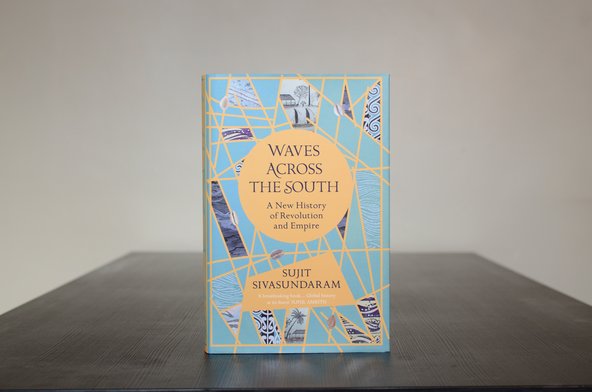
Starting from the ocean and from the forgotten histories of ocean-facing communities, this is a new history of the making of our world.
After revolutions in America and France, a wave of tumult coursed the globe from 1790 to 1850. It was a moment of unprecedented change and violence especially for indigenous peoples.
By 1850, vibrant public debate between colonised communities had exploded in port cities. Yet in the midst of all of this, Britain struck out by sea and established its supremacy over the Indian and Pacific Oceans, overtaking the French and Dutch as well as other rivals.
Cambridge historian Sujit Sivasundaram brings together his work in far-flung archives across the world and the best new academic research in this remarkably creative book.
Too often, history is told from the northern hemisphere, with modernity, knowledge, selfhood and politics moving from Europe to influence the rest of the world.
This book traces the origins of our times from the perspective of indigenous and non-European people in the Indian and Pacific Oceans.
About the author
Professor Sujit Sivasundaram is a British Sri Lankan historian and academic.
He is currently a professor of world history at Gonville and Caius College, University of Cambridge. Sivasundaram was awarded the Philip Leverhulme Prize for medieval, early modern and modern history in 2012.
He was co-editor of The Historical Journal and was associate editor of the Journal of British Studies.
Extract from the book
In the mid 1820s, the waters of the Bay of Bengal created a new danger for the kingdom of Ava in upper Burma. Invaluable and unusual letters written by a Buddhist monk called Kyi-gan shin gyi, or "The Elderly Novice of the village of Kyeegan [Kyi-gan] Lake" are indicators of what was afoot.
This monk’s real name was Maung Nu. He did not rise above the status of a novice monk. Instead, he led an itinerant life and moved in the circles of trade and the law. When his fame as a scholar spread, he was invited by King Bo-daw-hpaya to take up residence at his capital in Amarapura, now within reach of Mandalay in northern Burma/Myanmar. Kyi-gan shin gyi’s epistles were written on palm leaf. They are Myit-taza or letters of loving kindness, cast in a language which was meant to seem familiar to the Burmese villager. They were probably written on behalf of people who could not write to their relatives. They point to the plight of people caught up in the changes brought about by the centralisation of the Burmese kingdom of Ava and greater European trade. These changes led to migration from the north to the coasts to participate in this trade.
"The Elderly Novice" wrote for a young man, "Lotus Leaf ", who had travelled down the Irrawaddy to Rangoon: "I should have written before I sailed. But in such trifling matters, the only important thing is love and affection." For "Lotus Leaf ", Rangoon was a city to which people came from across the Bay of Bengal: "all sorts of sailors, strangers and aliens in habit and custom, and belonging to many races all of which I cannot name". Among the people listed were Armenians, Roman Catholics, Portuguese, Africans, Arabs, all kinds of Indians including "Hindu Sardhus [holy men], Muslim crewmen and Bombay merchants".
They are hairy people with moustaches, side-whiskers, beards and shaggy legs. Energetic and alert, they hustle and bustle from place to place, round and round and up and down, in and out and to and fro, winding and curving, to all nooks and corners, east and north and west and south.
Particularly interesting is how this giddiness was contrasted with the steadiness of the people up the Irrawaddy in the north: "I hope that my dear people at home remain constant and true to me, like that silver lizard, undisturbed by the scandalous and untrue accounts of what I did and what I do". The silver lizard referred to the mariner’s compass, which in the words of the letter, "remains quietly constant always pointing to the north".
According to one explanation which circulated at the time, in these years before the First Anglo-Burmese War (1824–6), Burma was a regime conceited with the certainty of victory against the British. Such a characterisation of indigenous rulers and kings as "oriental despots" was common across Asia. The European idea came to influence other conflicts which we will turn to shortly, including in Java, Sri Lanka and China. But Maung Nu’s letters demonstrate instead a sensitive perception of danger, which is mapped on the land. The regions in the south along the coast and also the frontiers with British India are seen to be rife with turbulence. This was not then a kingdom uninformed of the wider world. In another epistle written by this monk, for an anxious father addressing his son, new and troubling songs are said to be sung in the heart of the kingdom. The stars are lined up against King Bo-daw-hpaya:
Both the astrologers and the general public are agreed that times are bad, the planets are unfavourable and dangers are ahead for both the King and kingdom . . . Unfortunately for you, my son, you are in the path of his mighty army of destruction, as your business takes you to the great towns on the seaboard, for example, Dallah, Syriam, Martaban, Sittang, Thaton, Moulmein, Pegu, Hmawbi. These maritime regions of our country shall be the scene of our King’s greatest victory, but they will also be the scene of disaster and destruction wrought by his might.
Kingdoms like Ava and Kandy, the latter being the interior highland kingdom of what is now Sri Lanka, and the island’s last remaining independent foothold, are often presented as landlocked. Asian regimes of the period are traditionally seen to have not had the skills to engage the technological and military capacities of maritime Europeans. This applies especially to their response to the advance of the British who invaded these territories during and after the Napoleonic wars and across the seas. Yet contrary to such an interpretation, there was a stand-off on the Irrawaddy River in the midst of the First Anglo-Burmese War. In Sri Lanka, the British, coming from the coast again, first lost rather spectacularly to the interior kingdom of Kandy in 1803, before defeating Kandy in 1815.
During the late 18th and early 19th centuries, a critical technical gap opened up between European armies and navies and non-European forces. Yet this did not give rise to automatic success to colonisers. In Asian environments, logistics, terrain and transport continued to be difficult. One might add that this was particularly so in sea-facing places, where the terrain could change rapidly, ranging across coastal territories, highlands, rivers and swamps. Asian regimes responded actively, finding their path in the midst of European advance. Meanwhile, in these theatres, the fact that Europeans could not be certain of victory meant that they turned to extensive looting.